
March 05, 2012
Underwater Filmmaking Workflow Part 1: Before the Dive
For the past several months, I've been heads down on writing, filming and editing two short films -- one about camouflage, and the other about Blue Heron Bridge. Now that it's clear why I've been M.I.A. since Oct., lets get to the point of this blog post: workflow.
Where to start? Without question, the story! Never ever press play on your camcorder/DSLR until you have a story. But a story isn't enough. It must be different and unique. I'm getting sick and tired of watching underwater films that simply tell viewers about the creatures that inhabit a reef. I think the saying goes... been there, done that.
The Dilemma by Pete Fowler is a great example of a film with a unique angle. I wish I had a sample clip, but I don't. The Dilemma was screened at last year's San Diego Undersea Film Exhibition. The film answers a simple question: What is the plural of octopus? The film poked fun at octopuses versus octopi and included beautiful octopi (pun intended if you've seen the film) footage. The film's unique story drew laughter and applause from the audience.
I think drafting the story is the most challenging step in the workflow. I spend countless hours writing and just when I think the story is done, I write some more. At some point though, you've got to call it quits and move onto the next step: identifying shots to accompany each sentence in your story. The shots must tell the story visually. Well known underwater filmmaker Mike Boom recently taught me a valuable lesson. I sent him a short film for review and he replied saying, "I like your opening shot, but it has nothing to do with the story." He was right... the opening shot had nothing to do with the story, but I included it anyway because I thought it was pretty. Big mistake.
If one of your sentences says, "the octopus is a master of camoflauge," then you need to visually show the octopus being a master of camouflage. While you may have gotten a great shot of an octopus crawling across the sea floor, your unproperly exposed shot of the octopus blending in with the reef is the most appropriate footage to use.
I spend a lot of time thinking about how to tell each sentence of the story visually. Then, I plagiarize. It's not what you think though. I go to VIMEO.com and watch films from profesional filmmakers like Howard Hall, Steve De Neef, Mike Elliott, Tony Wu and Rafa Herrero Massieu. When I find cool shots, I identify what makes them cool and think about how to incorporate them into my short film. Howard Hall once told me that he learned by watching other people's films. While it seems obvious, a lot of people overlook the lessons that can be learned simply by watching a film and taking notes.
Once I have all my shots outlined, I seperate them into two categories -- macro and wide-angle shots (I shoot with a Canon 7D, so I don't have the luxury of switching from wide angle to macro during a dive). Finally, I shrink them down to the smallest font I can read, print them out on a half a sheet of paper and laminate it; that way, I can reference the card during my dives to ensure I get all the shots I need.
The next step: the dive. But we'll save that for part two.
Posted by jroualdes at 11:18 PM | Comments (0)
October 20, 2011
Despite Humidity & Mosquitos, Florida Rocks
I just returned from Florida, where I dove Blue Heron Bridge and Blue Spring. Long story short, mantees are playful and inquisitive, scorpion fish are extremely well camouflaged, squid are dazzling and the Atlantic Ocean is a jacuzzi compared to the Pacific. I'll post dive profiles of both sites soon. In the meantime, here is a rough cut video of my dive at Blue Heron Bridge.
PS -- If you haven't visited Blue Heron Bridge, book a trip now. It's worth every penny.
Posted by jroualdes at 06:21 PM | Comments (0)
September 12, 2011
San Diego UnderSea Film Exhibition Recap
Having never attended or participated in a previous San Diego UnderSea Film Exhibition, I didn’t know what to expect from this year’s exhibition. What will the venue be like? How many people will attend? What will the quality of the short films exhibited be? Will the professional filmmakers attend? These are all questions I asked myself beforehand.
Full disclosure -- I was fortunate enough to have my first short film, “Peace & Quiet,” screened at this year’s exhibition, so I’m admittedly biased. That said, from the venue, to the number of attendees, to the quality of the films screened, to the professional filmmakers in attendance, this year’s SDUFEX blew my mind.
The exhibition was founded in 2000 by several divers/underwater filmmakers -- including Mary Lynn Price, Chuck Nicklin and Karen Straus -- to showcase the world’s best underwater short films. This year's SDUFEX, held at Irwin M. Jacobs Qualcomm Hall Sept. 9-10, featured 34 short films from professional filmmakers like Howard and Michelle Hall, J.D. Duff, Mary Lynn Price, and amateurs like me. Michael Gates also presented the winning film from its "Capture the World" competition.
When I arrived at the exhibition on Friday night, I was immediately impressed by Qualcomm Hall--it's a spectacular, state-of-the-art 534-seat hall intended to be used by non-profit organizations. Undulating blue and green lights and underwater still photos projected on the 22x30 foot screen made it feel like Qualcomm Hall was underwater.
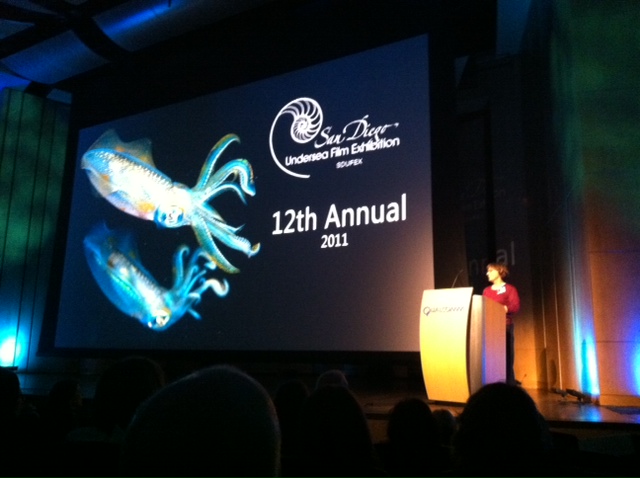
Qualcomm Hall
One of the biggest questions I had leading up to the exhibition was "How many people would attend?" The hall was filling up quickly, with only a handful of empty chairs remaining. After taking our seats, my girlfriend Carolina and I noticed a line forming on the isle to our right. My eyes started at the end of the line, backtracking to its source—Howard and Michelle Hall sitting directly behind me. Being the Brad Pitt and Angelina Jolie of underwater filmmaking, everyone was taking the opportunity to say hello. I knew that the Hall's film, "100 Miles," was the last film being shown at the exhibition, but I honestly didn't expect them to be in attendance. The pressure was on--my film screened two films before the Hall's.
A few minutes later, the lights dimmed and the exhibition’s hosts -– Karen Straus and Ken Given –- took the stage. Karen sported a white t-shirt with a BCD and scuba tank imprinted on it. She exuded excitement. Ken wore a tuxedo shirt with matching purple Converse. He was noticeably more nervous than Karen, but his critique of his occasional fumbling of lines was endearing. The duo worked well off each other and kept the attendees entertained.
While Simon Spear's "Circle of Life” kicked off the exhibition, I was floored by Nannette Van Antwerp's “Pacific Drifters." She was in attendance, but elected not to personally introduce her film. Her second film, “Crustaceans of Ambon," screened Saturday night and was equally impressive.
Around 9:30 pm, the exhibition's first night ended and we headed to P.F. Chang's to eat, drink and recap the exhibition. We concluded that Friday night’s films fell into two categories -- films with music and films with music and narration. Being a writer, I naturally gravitate towards the latter category. I personally think the biggest opportunity for amateur underwater filmmakers lies in their ability to shoot stellar video, write a compelling narrative and choose music that amplifies emotions.
Carolina kept me busy Saturday. She knew that if she brought me back to our hotel room too early, I’d bounce off the walls with nervous energy and drive her nuts. We jogged around La Jolla Cove and enviously gawked at the divers entering the water. One diver told us that the cove was a great place to see leopard sharks, which I badly need footage of. Unfortunately, there wasn’t enough time to dive and attend the exhibition.
When we arrived at Qualcomm Hall that evening, a line had already formed from the hall’s back door stretching out across the lobby. Petrified, I walked up to the front desk to get our tickets. Since my film was being screened that night, I was given a badge that said “Filmmaker” in bold black letters. It should have said “Lucky to Be Here.” The badge was like tucking my shirt into my underwear -- it drew stares. The doors opened and Carolina and I made a b-line for the seats we sat in the previous night. The seats quickly filled up and people kept streaming in -- it was a packed house.
The lights dimmed, Karen and Ken again greeted attendees. This time, Karen wore a shirt featuring glow-in-the-dark fish that didn’t glow. Not to be outdone, Ken sported an orange tuxedo shirt with matching Converse.
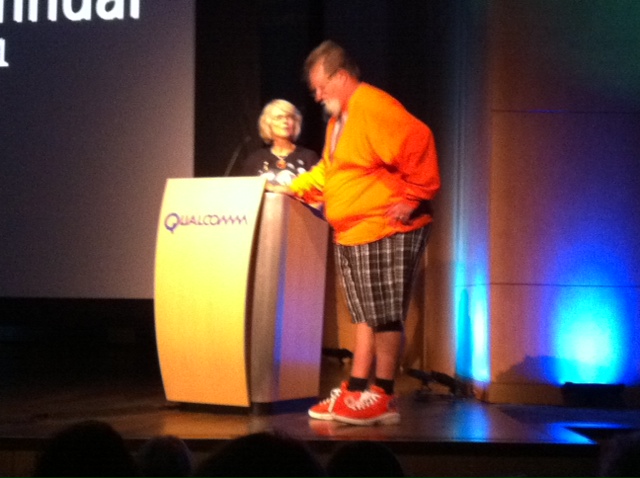
Karen and Ken
Saturday's films were as impressive as Friday's. Before long, it was my turn to introduce “Peace & Quiet.” As instructed, I walked to stage under the cover of dark while the film before mine played. I worked my way up the staircase to the right of the stage and sat in an empty chair next to Ken. I was comfortable the entire night. But now my underwear was riding up my butt and my socks were bunching up in my shoes. I was quickly losing my cool.
These past two nights, I’d paid particularly close attention to what people said during their introductions. Like the films, Carolina and I broke the introductions down into two categories -- nonchalant introductions and serious introductions. I don’t take myself too seriously, but I was really excited to be at the exhibition, so I decided to take a different route with my introduction. My game plan solidified meer minutes before I found myself sitting next to Ken, growing increasingly nervous, counting down the seconds until I was introduced. I whipped out my iPhone and took a photo of the audience to ease my nerves.
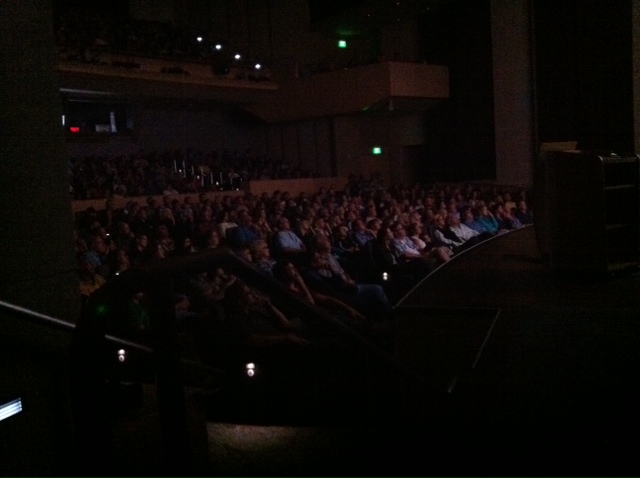
Photo of the audience from the left side of the stage
Then I realized Karen was at the podium introducing me. Two weeks prior, Karen had emailed me to ask how to pronounce my name. I told her that everyone mispronounces my name. To emphasize the point, I shared that an announcer once called me Joe Rolaids during a baseball game. Karen found it so ammusing that she recounted the story to the audience. I thought to myself, “Not a bad start, thanks Karen.”
As I made my way to the stage, Karen extended her hand. I awkwardly shook her hand, took a few steps to the podium, began anxiously rubbing my hands together and launched into my introduction...
My introduction, filmed by Carolina
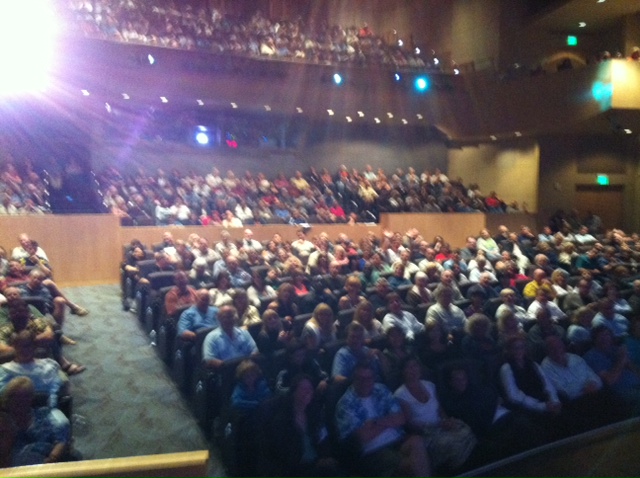
The photo I took during my introduction
After my introduction, I walked off the stage where I was hugged by Karen and given a blue mug with the SDUFEX etched into it. I stopped in the isle against the right wall and watched my film.
I thought I’d be nervous seeing my film projected on a screen a few hundred times larger than my living-room TV in front of more than 500 people. I wasn’t. I felt a sense of accomplishment.
Three minutes and thirty five seconds later, it was over. J.D. Duff introduced his film shortly thereafter, followed by Howard Hall. Naturally, both were stunning. Howard’s ended with, “Everything in this film was shot within 100 miles of where you sit.” The audience errupted.
While the exhibition was over, SDUFEX was holding a dinner for the filmmakers at the nearby Hyatt. I wasn’t at the dinner to eat and drink. I was there to network with other filmmakers. Grasping a Manhattan in one hand, I ask questions like, “What is your workflow,” to anyone who would listen. Midway through a conversation with Mary Lynn Price, who is an extremely genuine person, not to mention a great filmmaker, Howard Hall sat down across the table from me and Michelle Hall sat to my right. Mary immediately turned to him and said, “Howard, have you met Joe? You should answer his question.” For the next 45 minutes, Howard, Michelle and Mary took turns answering all my questions.
I learned a lot in 45 minutes. But one thing stood out. When I asked Howard and Michelle to describe their workflow, Howard put both hands face down on the table, leaned forward and shot me a stare reminiscent of Dirty Harry. He emphasized the importance of writing the narrative and then identifying the shots needed to visually tell the story before starting to film. While he’s perhaps best known for his footage, his passion for writing was evident.
Around midnight, everyone got up, pushed in their chairs, said their goodbyes and headed home. I'd been riding an emotional roller coaster all weekend. While the ride, SDUFEX, was over, adrenaline was still coursing through my veins. Back at our hotel, I couldn't sleep so Carolina and I recapped the exhibition. Surprised best summed it up. Surprised by the beauty of the venue, quality of the films and number of attendees.
What surprised us most though were the filmmakers -- they were unbeievably friendly, thoughtful and generous. Howard, Michelle, Mary and every other filmmaker could have ignored us at dinner, and I wouldn't have blamed them. But they didn't. I couldn't have asked for a better birthday and can't wait for next year's SDUFEX.
Posted by jroualdes at 06:55 PM | Comments (0)
August 24, 2011
San Diego UnderSea Film Exhibition Serves Up Best Birthday Ever!
Sept. 10 is going to be a great day. Not because it's my 30th birthday, but because my first underwater short film--"Peace & Quiet"--has been selected to be shown at this year's San Diego UnderSea Film Exhibition on Sept. 10.
Many of the exhibition's organizers and judges are professional underwater filmmakers, like Mary Lynn Price, whose work I greatly admire and follow. What's also humbling is that my amatuer film is included in the same program as Howard Hall's "100 Miles" and J.D. Duff's "Cocos Island, Costa Rica." Can you believe that? I feel very fortunate to be able to say that.
I'm attending the exhibition and will tweet live from my Twitter handle @jroualdes Sept. 9-10. The week after, I'll post a blog recapping my experiences.
Posted by jroualdes at 04:45 AM | Comments (0)
Two Shark Attacks Perplex Russians
There hasn't been a single recorded shark attack in Primorsky Krai--a region in far East Russia along the Sea of Japan--until now. Denis Udovenko, 25, was attacked on Wednesday, followed by Valery Sidorovich, 16, on Thursday. Both survived, but Udovenko lost both arms below the elbows. Authorities have temporarily banned swimming at several nearby beaches.
For the full story, read Michael Schwirtz's New York Times article here.
Posted by jroualdes at 01:04 AM | Comments (0)
August 19, 2011
The One That Didn't Get Away
Fisherman John Goldfinch had a big one on his line. But it wasn't a mackerel. It was a diver. Goldfinch's hook caught him right between the legs. "The funniest thing was that his girlfriend then surfaced, helped him remove my tackle from his tackle and nonchalantly handed the hook back to me and apologised," he said.
Click here for the full story.
Posted by jroualdes at 10:21 PM | Comments (0)
August 15, 2011
Contraversial SHARK WEEK Footage Creating a Frenzy
An interesting conversation has popped up on Wetpixel. Adam Hanlon reports that Discovery Channel’s show How Shark Hunt, which aired as part of SHARK WEEK, included “controversial footage.” In the footage, the famous tiger shark Emma “is baited and when she takes the bait, is pulled by the crew up towards the surface. The shark resists and the line holding the bait parts, causing the gantry arm to which it was attached to swing round and strike the crew.”
The footage prompted Hanlon to ask Wetpixel forum members if “this sort of activity really acceptable for people's entertainment and does this do any good for shark or marine conservation?” In response, one person said, “Discovery & Shark Week are BOGUS, moronic & destructive.” Another said, “I haven’t watched a Shark Week program in over a decade. This shows I’ve made the right decision.” I searched for positive responses, but was unable to find any.
As I’ve said before, I’m not a fan of SHARK WEEK. Sadly, this video pretty much sums up why. I’m doubtful the Discovery Channel will learn its lesson though because SHARK WEEK opened to 3.3 million viewers its first hour, which was one of the annual programming event's best Sunday night numbers ever.
Do you think SHARK WEEK does anything good for shark conservation?
Posted by jroualdes at 07:10 PM | Comments (0)
August 12, 2011
What About Bob?
Ten minutes into our boat ride from Lahaina to Molokai, our dive master shepherded me and 12 other divers into the boat’s cabin for our pre-dive brief. One person remained—a man appearing to be in his sixties, sporting white stubble, tattered tan shorts and a blue shirt. “Should I grab him,” I asked. “Nah, that’s just Bob,” the dive master replied before drawing circles on a whiteboard representing two pinnacles that jutted from the ocean two miles off Molokai’s East shore. “Here is where the scalloped hammerheads are,” he said while drawing a big X.
My attention immediately shifted from Bob to the hammerheads. They’re the reason I woke up at 5 a.m. on my vacation and braved a 45-minute boat ride in six-foot swells. About those swells—the Pailolo Channel separating Maui and Molokai is one of the roughest channels in the world, and it was living up to its reputation. The six-foot swells tossed the boat side-to-side like a pendulum making it difficult to focus on the brief and stay dry.
Suddenly, a loud thud rang from the back of the boat. Everyone spun around, fearing a tank had fallen from a rack and crushed their gear. Bob was in the middle of the boat’s deck, wearing a camouflage wetsuit, wrestling with a rebreather. Despite the swells and waves that littered spray across the boat, Bob had managed to gear up. But he wasn’t done. He waved over our dive master, who quickly clipped a bright yellow tank to his waist, and then handed him a camcorder in a large Gates housing. With all his gear, Bob looked more like an astronaut than a diver. Just then, the boat pulled up to the pinnacles and idled. One giant stride later, Bob was gone. The boat’s crew shouted, “Bob’s away!”
Who the hell is Bob? Unsatisfied by the answer the diver master had given me earlier, I scrambled up the ladder to the captain. “Bob is Bob,” he said. I was beginning to think the crew had something against me. “He’s been diving this sight twice a week for the past year,” he said. “He’ll meet up with you guys at the end of your dive. You can interrogate him then.” Pleased that I’d uncovered some info about Bob, I headed down the staircase to prep for my dive.
One hour later, I was back on the boat, without Bob. “I thought you said Bob would meet up with us at the end of our dive,” I said to the captain. “Yeah, your second dive.” Bob’s rebreather didn’t expel bubbles that frighten hammerheads and it allowed him to stay down for hours at a time.
Nearing the end our second dive, Bob appeared. He was hovering behind a ledge preparing to ambush a camera-shy, five-foot-long barracuda. As we boarder the boat, I overheard Bob talking to a dive master. “I’ve never been so close to a hammerhead,” he said, sporting a grin from ear-to-ear.
“He likes chocolate chip cookies,” a dive master said. “I’m sorry,” I replied. “Bob, he likes cookies.” I immediately made a b-line for the cookie jar, snatched two and then approached Bob. “Would you like a cookie,” I asked. He looked up and said nothing. “Would you like a cookie,” I repeated. “You’ll have to speak up,” he replied. I thrust the cookie towards him. “Oh, thanks!”
With my peace offering accepted, I began hurling questions at Bob: How close did you get to the hammerhead? Are you an underwater filmmaker? Why do you dive the site so frequently?
“The shark got so close it almost swallowed my camera lens,” he said, cracking a smile. Slowly but surely, Bob opened up.
At one point, he casually mentioned that he’d been a black coral diver “a long time ago.” A jewelry store owner had told me earlier in my vacation that black coral is rare and extremely difficult to harvest. It grows at depths exceeding 200 ft.—exposing divers to several potentially deadly hazards like nitrogen narcosis and tiger sharks. To say that black coral diving is dangerous is an understatement, and back then Bob didn’t even have the benefit of modern dive technology and mixed gases.
Then I asked the inevitable question: What was your most dangerous dive? Bob took a bite of his cookie, seemingly reluctant to indulge me. Perhaps he didn’t want to talk about close calls or maybe he’d had so many that he needed time to choose which story to tell me. Bob swallowed, and then dove into his story.
He was 45 minutes or so into a dive around 180 ft. when he went to flip the J valve to access his reserve. But when he reached back, he couldn’t feel the hanger. He removed the tanks from his back to take a closer look and discovered the hanger was gone. 180 ft. down, 45 minutes into his dive with an empty tank and no way to access his reserve, Bob removed his belt and bolted for the surface. When he porpoised, the boat crew immediately tossed him a tank with a regulator attached to it. Bob descended to 100 ft. to decompress. At that point, it became clear to me why Bob was hard of hearing. He should have died that day, but he didn’t. “Someone was looking out for me,” he said.
Some of his friends weren’t so lucky. Some were killed by decompression sickness and air embolisms, one was attacked by a tiger shark and others simply didn’t return from dives.
The next day, I stopped by Bob’s Front St. shop, Whaler’s Locker. The store offers sun burnt, tropical shirt sporting tourists jewelry, most of which comes from the sea. It’s as much a museum as it is a jewelry store. Bob’s daughter was working behind the counter. Making small talk, my girlfriend Carolina mentioned that I’d been on a dive boat with her father. She said divers frequent Whaler’s locker boasting that they’d dove with Bob, which annoyed her. “They didn’t dive with my dad, they were on a boat with him,” she said.
Since we passed her test, she began to tell us more about Bob. Surprisingly, he’d stopped diving altogether several years ago. It wasn’t until she invited him to “tag along” for an open water course that he got back into diving. After completing the open water course, Bob took several more courses and eventually purchased a rebreather. His daughter had considered purchasing one too, but decided against it when she read the manual that accompanied it. “Every other word was WARNING,” she said. “That thing has 100 ways to kill you.”
Two days later, I left Maui and a crew of filmmakers arrived. They were putting the final touches on a documentary about black coral divers and needed to interview Bob. He told me that he was apprehensive about the film because he hadn’t told his family much about his experiences black coral diving. “I guess they’ll know now,” he said.
Posted by jroualdes at 09:20 PM | Comments (0)
March 28, 2011
Sea Lions at Breakwater Wall!
If you live in Northern California and long to dive with sea lions, head to Breakwater Wall in Monterey. More sea lions than you can shake a stick at have returned from breeding in Southern California and Baja and are jostling for space along the rocky wall. Yesterday, several friends and I headed down to dive Breakwater Wall. While visibility was poor -- only 15 feet -- the sea lions didn't disappoint. See for yourself:
Sea Lions @ Breakwater Wall from Joe Roualdes on Vimeo.
Posted by jroualdes at 04:00 PM | Comments (0)
March 17, 2011
The Frugal Photographer: UW Tripod
This is the first video in a new series we're calling "The Frugal Photographer." So what inspired this series? My macro videos we’re shaky, and as a result, unappealing to view. When I began researching underwater tripods to stabilize them, I was shocked by how expensive they were—$400 and up. After some deliberation, I decided not to purchase a tripod since I’d already spent a lot on a Canon 7D, Ikelite housing, multiple lenses and ports and an Ultralight arm and SOLA1200 video light. Inspired by Tony Wu, I made one myself for just $60.
Next video, we'll illustrate how to build an inexpensive snoot. Let us know if you have any questions or requests for future Frugal Photographer videos.
ScubaDiverInfo, The Frugal Photographer: UW Tripod from Joe Roualdes on Vimeo.
Posted by jroualdes at 04:56 PM | Comments (0)
March 10, 2011
Only 219 Great Whites Live Off California's North Coast
That's according to a recently published, first-ever census conducted by post-doctoral students at UC Davis over the three years.
"The number seems incredibly low--it was very surprising for us," said Taylor Chapple, who published the report in this week's journal Biology Letters. "If you look at other protected marine mammals such as polar bears or killer whales, their populations are far bigger than white sharks."
Chapple's team floated seal decoys between Bodega Bay and Monterey. When the sharks surfaced to explore the decoys, his team took photos of the shark's distinctive fins, which were used to help tell the sharks apart and calculate the total population.
Unfortunately, this study is the first-of-its kind, so it is still uncertain whether or not great white shark populations are rising, falling or stable. On the bright side though, this is a step in the right direction.
Posted by jroualdes at 10:49 PM | Comments (0)
March 03, 2011
We're Going to the San Francisco Ocean Film Festival!
ScubaDiverInfo is attending the San Francisco Ocean Film Festival--a volunteer-driven non-profit dedicated to using film to increase public understanding of the environmental, social and cultural importance of marine ecosystems and foster a spirit of ocean stewardship.
We're attending "Program 7: Sharks & Vanishing Marine Life" Saturday starting at 1:00 pm PT. If you're interested in attending the festival, but can't, don't worry--we're tweeting live throughout. My Twitter handel is @jroualdes if you're interested in following the conversation online. I'll also post an article shortly thereafter summarizing key takeaways.
While all of Program 7 looks promising, I'm personally most excited about the "Sharks, Fins and Sustainability" panel starting at 3:15 pm PT.
Posted by jroualdes at 01:37 AM | Comments (0)
January 03, 2011
$500 Underwater Tripod... No Thanks!
Three days and counting until I travel to Maui for a week to shoot footage for a short film my girlfriend and I have been working on and are hoping to enter into several upcoming film festivals. While I've got most of the gear I need, I still don't have an underwater tripod. No problem, it can't cost that much, right? Wrong! Most tripods cost between $400 and $500.
After all the money I've spent on lenses, housings, video lights, memory cards, no I have to spend several hundred more bucks on a tripod? Not necessarily. Two weeks ago, I was reading Tony Wu's blog, which I recommend all underwater photographers and videographers read, and noticed a photo he'd taken of the rig he used during his recent trip to Ambon. Are those two Gorillapods mounted to his tray? Yeah!
In his blog, Wu says his rig included, "a few Gorillapods, and a bunch of homemade bits and pieces held together by miscellaneous nuts, bolts, tape and crossed fingers." Now, I'm no engineer. But if Wu can do it, I'm sure I can.
Two days, three trips to the hardware store, two trips to the camera shop and $60 bucks later, my underwater tripod is done:
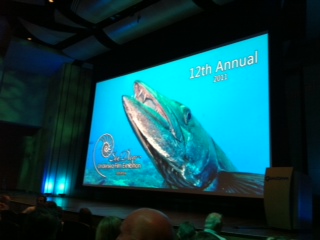
While mine can't pan-and-tilt like the $500 tripods and will eventually rust at certain areas, it saved me $440. When I return from Maui, I'll post a video tutorial showing how I built my underwater tripod and how easily you can do the same.
Posted by jroualdes at 09:43 PM | Comments (0)
December 22, 2010
U.S. Senate Approves Shark Conservation Bill
Yesterday, the U.S. Senate approved the Shark Conservation Act, which aims to resolve loopholes in a shark finning law passed more than 10 years ago. The act requires "any vessel to land sharks with their fins attached" and would prevent non-fishing vessels from transporting fins without their carcasses, according to Washington Reporter Juliet Eilperin.
To garner North Carolina Senator Richard Burr's support, an exemption was made allowing people catching smooth dogfish off the state's coast "to bring in fins separately, as long as they account for no more than 12 percent of the total weight of the catch."
While most environmentalists reportedly support the act, it is still uncertain whether or not President Obama will sign it.
Posted by jroualdes at 09:48 PM | Comments (0)
December 11, 2010
Point Lobos Dive Profile
Often called "the crown jewel of the State Park System," Point Lobos State Natural Reserve is one of Northern California's most beautiful and diverse dive sites.
Point Lobos is located in Monterey County, three miles south of Carmel on Highway 1. It opens daily at 8 am and closes a half hour after sunset. An entrance fee of $10 per vehicle ($50 per van or small coach) and $10 per diver is charged.
Two-diver teams are allowed to dive Whalers and Bluefish Coves by reservation only. Check the dive calendar before making your reservation to identify which days are available. If you don't make your reseravation several weeks in advance, good luck. Spots fill up quickly. For those of you who don't heed my advice and chose instead to show up at Point Lobos without a reservation only to be turned away, try Monastary Beach just North of Point Lobos. Worth noting is that reservations aren't transferable or refundable.
On Nov. 24, my brother Garrett and friend Tim dove Whalers Cove. Two days earlier, a storm tore through Northern California. That morning though, we were greeted by sunny skies as we pulled into the parking lot. At the end of the parking lot, there's a staircase that leads to a lookout. I recommend every diver survey Point Lobos and plan their dive from this lookout before entering the water. Despite the sunny skies, three to six foot swells crashed into pinnacles just outside Whalers Cove, sending white wash exploding into the sky. To dive safely, we had to dive well away from the pinnacles or risk being thrown into them.
I love diving Point Lobos. But there's one thing I dislike about it--the surface swim. Without a DPV or boat, divers must surface swim roughly 50 yards from the entry point to the South-West point of Whalers Cove before descending because the visibility is often poor in the cove. During the summer, the surface swim can be a pain due to the increased kelp. That doesn't bother me though. What does is being exposed on the surface, where I'm vulnerable to great white sharks. I know, I know. I've read the statistics and I know how unlikely being attacked by a shark is. However, that's probably what Marco Flag was thinking on June 30, 1995, when he was attacked by a great white shark at Blue Fish Cove--the cove adjacent to Whalers Cove. Fortunately, Marco wasn't injured because the shark's jaws clamped down on his tank and a box attached to the front of his weight belt. While I'll likely never see a great white shark outside the Monterey Bay Aquarium, I still like to limit the time I spend on the surface.
After returning from the lookout, we emptied our gear from the car onto two picnic benches. Unlikle Lover's Point and Breakwater, Point Lobos has no grass and the parking lot is comprised of dirt. I recommend divers place their gear on the picnic tables to keep everything clean. While gearing up, an old man walked by us and said, "You're getting into the water. Little cold. Hope you don't die." I thought to myself... not exactly what you want to hear before a dive.
A few minutes later, we entered the water. We surface swam out to the South-West Point, made sure there was no kelp below us, took a compass heading off the pinnacles, then descended. "Crap," I thought to myself as I sunk to the bottom. Less than five feet of visibility, less than one minute into the dive and I've already lost sight of Garrett. Needless to say, conditions were less than stellar. A minute of two later, and we were all back together. Our plan was to swim on the compas heading to the pinnacles along a sand channel, then turn around on our recipracle and head back. Surge was stronger than expected, kicking up walls of sand.
Ten minutes later, we'd descended to 45 ft., the temprature was dropping and conditions hadn't improved. That's when we decided to head South, rathern than proceeding West along the sand channel. We hoped that conditions were better inside the kelp beds along the point. It was a gamble we're all glad we took. Five minutes later we entered the kelp beds just outside Whalers Cove and we're rewarded with nearly 40 ft. of visibility. We spotted a five-foot long leapord shark, which appeared out of nowhere, then slowly swam in between the kelp stocks and out of sight. We also stumbled across a wolf eel hunting in the open. I'd never seen a wolf eel before, and was surprised by it's size--about four feet long and stocky in comparison to a moray eel.
Nearly an hour later, we reluctantly surfaced. On our surface swim back, we each enthusiastically recounted our favorite parts from the dive. Despite poor conditions initially, it turned out to be another great Point Lobos dive.
Here's the video from our dive:
Whalers Cove from Joe Roualdes on Vimeo.
Posted by jroualdes at 12:32 AM | Comments (0)
December 08, 2010
Maui: Black Rock Dive Profile
One of my favorite Maui dive sites is Black Rock--a large lava rock that divides Kannapali Beach. It's known for being a great spot for night dives, cliff jumping and seeing some of Maui's biggest green sea turtles.
Black Rock is nearly 200 yards in length, running North-South. At its deepest it's only 30 ft. It's flanked by a reef that roughly 30 yards wide. Before diving Black Rock, contact Lahaina Divers and ask about the dive conditions. If the swell is coming from the South, conditions will likely be ideal. If the swell is coming from the North, be careful. The current at the North point of Black Rock has pulled divers out to the channel seperating Maui and Molokai.
It has two entry points, North of South. Unfortunatley, parking isn't easy. I recommend divers drive all the way to the North end of Kannapali Parkway, just past the entrance to the Sheraton Maui Resort and Spa. Park the car, remove your gear and place it on the grass next to the golf course. Make sure someone stays with the gear while the driver parks the car. Driving South on Kannapali Parkway, there is a small, I repeat, small parking lot North of Whalers Village. Parking is usually avilable before 9 am. After that, good luck.
Gear up on the grass, then walk along the path towards the Beach. There is beach access after you cross the bridge over the golf course fresh water runoff canal. Once you're at the beach, double check your dive gear and then enter the water.
You'll swim South along the North point of Black Rock. The first thing you'll notice is that the brakish fresh water from the golf course mixes wit the salt water--creating an onion-soup like mess that reduces visisbility. Stay the course! It quickly clears up. Swimming South, Black Rock will be on your left. I recommend swimming close to the wall on your way down, then swimming to the outside of the reef on your way back.
Along the wall there, are numerous small caves that green sea turtles use for shelter. During my last trip, my girlfriend Carolina and I nearly aborted our dive due to laughter when we stumbled upon a turtle at least 5 ft. long with its head stuck in a tiny hole and the rest of its body out in the open. While this defense may work for ostriches, it doesn't work for green sea turtles.
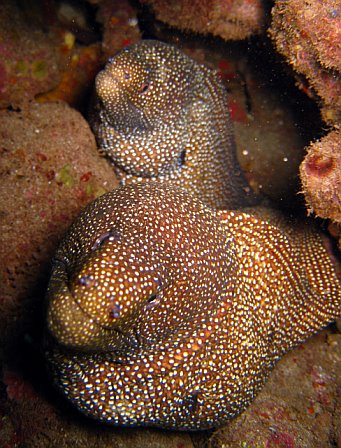
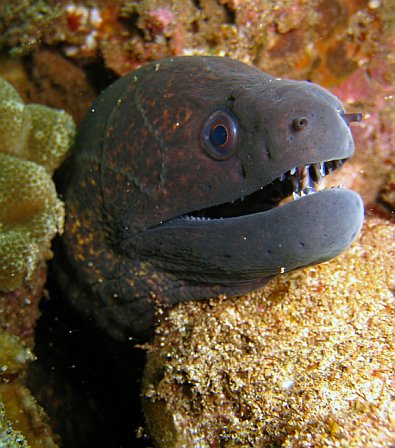
The small holes littering Black Rock are also a favorite home for moray eels. I've seen moray's on almost every dive I've made there. I've even seen multiple ones sharing the same hole. While moray eels are beautiful, they also bite, so be careful not to get too close.
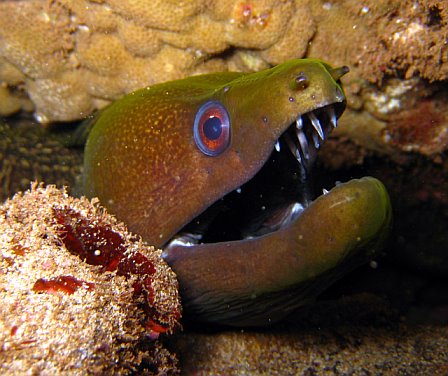
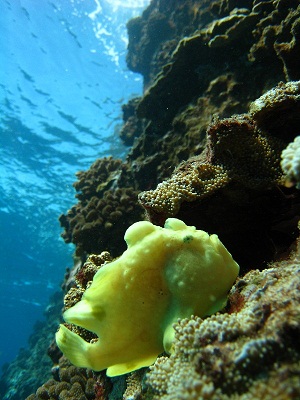
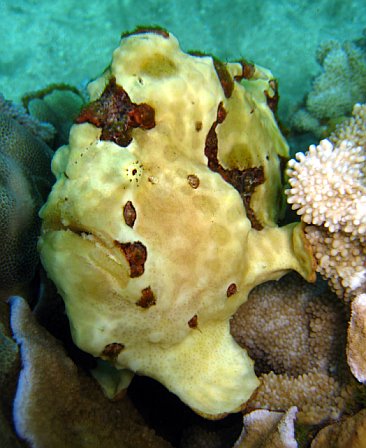
Also keep your eyes peeled for small, brightly colored objects that don't quite fit in with their surroundings. They're likely frog fish--a type of anglerfish. Frogfish are a favorite subject for photographers and videographers, but it's not because of their looks. Frogfish are stocky, ranging in size from 1-15 inches long. Their brightly colored bodies have no scales and are covered in algae or hydrozoa to help them blend in with their surroundings. Frogfish use their pectoral and pelvic fins like hands to hold themselves in place on a reef or walk along the sea floor and hunt by lying motionless until prey approaches. Then, in a fraction of a second, they open their mouths, take a deep breathe and swallow their prey whole.
For me, a trip to Black Rock isn't complete without seeing at least one frogfish.
Work your way down Black Rock until you reach the South-most point. You'll know you're there when the wall takes a sharp turn left, running East, and you see people diving into the water. Then, turn around and head back North. I recommend sticking to the outside of the reef this time, instead of hugging the wall.
Keep an eye out for green sea turtles. Sometimes I like to sit in the sand at the South Point of Black Rock waiting for them to swim by. On a single dive one afternoon I counted 14 turtles swimming South. I'm not sure why, but the green sea turtles seem to use Black Rock as a South-bound highway in the late afternoons.
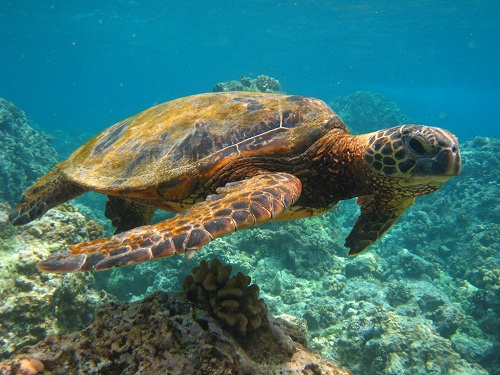
On the outside of the reef you'll likely come across several green sea turtles resting in the sand. While most will swim away when approached, some are inquisitive. During the last dive I made at Black Rock, a turtle crawled across the sand towards me, stopped, then lifted its face to my mask. Inches away, the green sea turtle analyzed my mask for several minutes. It is one of my most memorable diving experiences.
I hope your dives at Black Rock are as memorable as mine.
Posted by jroualdes at 10:32 PM | Comments (0)
December 06, 2010
The Making of Under the Sea 3D
What weighs 1,200 lbs., cost $5,000 to operate for three minutes and requires the film to be changed every three minutes? If you guessed Howard Hall's IMAX underwater camera system, you're right. He recently posted a video to his VIMEO account showing his team using the camera system, which he says is "the most impractical underwater camera system ever invented," to film great white sharks in South Australia for the IMAX film Under the Sea 3D.
That means Hall's IMAX underwater system weighs as much as a horse and the 40 minutes of footage from the movie cost roughly $65,000 to produce.
What I like most about the VIMEO video is that it includes communications between Hall's team captured by Ocean Technology Systems underwater communications devices embedded in their rebreather mouthpieces.
Three minutes and nine seconds into the film, Hall turns his back on a great white shark. A female diver, who I assume is Hall's wife Michele, says, "behind you." Hall responds with, "I never saw that one coming," which draws laughs from his team.
Here is the video:
Filming Great Whites from Howard Hall on Vimeo.
Posted by jroualdes at 03:06 AM | Comments (0) | TrackBack (0)
November 02, 2010
Shooting HD Video with Digital SLRs: What You Need to Know
Last November I purchased a Canon EOS 7D for shooting underwater video. When I opened the manual, I was overwhelmed by a wave of questions... Which frame rate is best for posting video online—60p, 30p or 24p? Which Picture Style Menu Setting is the best for underwater videography? How are frame rates different from shutter speeds? How do I capture the whole scene in focus when shooting fast-moving subjects?
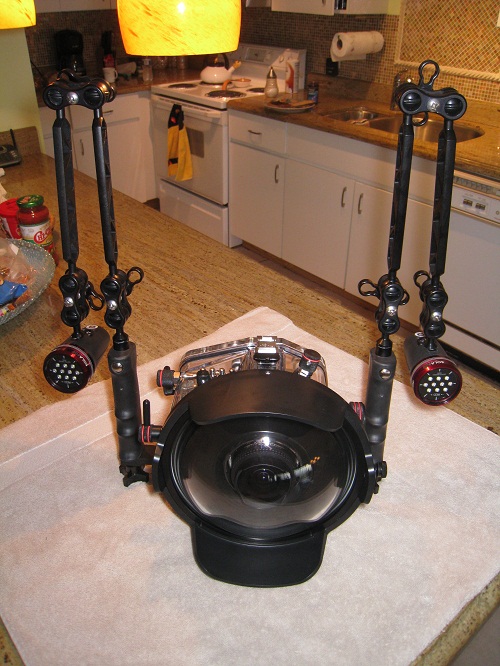
My rig: Canon 7D, Ikelite 7D housing, Tokina 10-17mm wide angle fisheye lens, 8-inch dome port with shade, Ultralight arms, Light & Motion SOLA600 focus and video lights.
The emergence of HD video capable Digital SLRs, like the 7D and Nikon D300s, has forever blurred the lines between camcorder and still camera. Unfortunately, Digital SLR videography is in its infancy, so I scoured various Web sites, posted numerous questions on VIMEO and called Backscatter more times than I can remember to find answers to my questions. If you're considering making the dive into Digital SLR video or are just getting your feet wet, here's what I think you should know:
Digital SLR Pros
• Censor Size: Digital SLRs have large CMOS sensors. For example, the Canon EOD 5D Mark II is 36x24mm and the 7D is 22x14mm. In comparison, the leading cinema camcorder the RED ONE is 24x13. Larger sensors gather more light and produce images with lower noise, which is critical considering the low-light conditions produced underwater.
• Cost: A full RED ONE body alone costs $17,550—more than six times the cost of the 5D Mark II body. Most prosumer camcorder housings start at $2,500, which is still more expensive than the Ikelite Digital SLR housings, which start at $1,500. Keep in mind that with both Digital SLR and camcorder housings, ports are an additional cost.
• Frame Rates: The most popular frame rate is 30p. However, Digital SLRs enable users to choose various frame rates. With the 7D, users can chose 60, 30 or 24p. I’ll explain later in this article which frame rate should be used for what scenarios.
• Depth of Field: Users can determine the depth of field by increasing or decreasing the aperture, which drastically alters the style of the video. For example, when I shoot macro subjects, like a decorator crab, I prefer opening my aperture to 2.8 and blurring the background to make my subject stand out.
BTW, did I mention Digital SLRs also take 18 megapixel still images?
Digital SLR Cons
• Stability: Digital SLR housing are more awkward underwater than their camcorder counterparts. They tend to be negatively buoyant and unevenly balanced—causing them to tilt forward and descend port down. To resolve this, most videographers attach buoyancy floats to their video light arms and attach tripods to their trays. Tripods don’t only stabilize macro shots—when swimming, videographers swing the tripod legs left, parallel to the tray. They hold the legs with their left hand and the right tray handle with their right hand, creating a wider grip that makes it easier to hold the Digital SLR stable.
• Continuous Video Autofocus: When shooting a fast-moving subject, like a Black Tip Reef Shark, it’s beneficial to have continuous video autofocus to ensure your subject doesn’t move in and out of focus. While the Nikon D7000 and D3100 and Sony Alpha55 include continuous autofocus, Canon’s Digital SLRs don’t. To overcome this obstacle, Canon users must narrow their aperture to between f/16 and f/22, which increases the depth of field or makes the whole scene in focus. While this quick fix sounds simply, it reduces the amount of light available to the sensor. In turn, you have to either boost your ISO, increasing noise, or introduce artificial lighting from video lights.
• Censor Overheating: Digital SLRs tend to overheat when they shoot video for prolonged periods of time. This is due to their compact form factor, which is devoid of cooling spaces. To prevent sensors from overheating, and being destroyed, the Nikon D7000 limits continuous shooting to 20 minutes. The 7D alerts users when the sensor is getting too hot, then automatically shuts down if the user doesn’t turn the camera off. For me, this is the most frustrating con. Last month I was in Florida filming macro subjects in Blue Spring when out of nowhere a manatee swam up to me. I swung the 7D around and up popped the alert, forcing me to shutdown the camera just as the action started heating up.
• Dedicated Lenses: This is my second most frustrating con and will arguably be the top one for people used to shooting video using camcorders. Unlike camcorders, Digital SLRs can’t transition from wide angle to macro underwater. Once you attach your lens and lock the housing, you’re stuck. When I assembled my rig for Blue Spring, I didn’t plan to see anything larger than a basketball, so I attached my Canon EF 100mm f/2.8 USM Macro Lens. When the manatee surprised me, I had to capture video of it using my macro lens. To get it into the frame, I had to swim 15 ft. away, putting lots of algae between us that produced video that wasn’t clear and had a greenish hue. My wide angle fisheye would have been ideal, but I couldn’t switch from macro to wide angle like most camcorder users. Here is the video:
Blue Springs, Florida from Joe Roualdes on Vimeo.
• Viewfinder: When you shoot video in shallow water, with sunny skies, the viewfinder can be difficult to see, which makes framing your subject difficult. This is less of a problem the deeper you descend.
• The Jell-O Effect: I’m sure you’ve heard of the dreaded “Jell-O Effect.” While the technical causes aren’t important, this is: Don’t worry about it. Abrupt, quick stop-and-go pans cause the Jell-O Effect. Since slow, fluid pans are visually appealing, and the aforementioned ones aren’t, your videos should never suffer from Jell-O Effect.
60p vs. 30p vs. 24p
• 60p is only available when shooting 1280×720 (720p). This frame rate is ideal for fast filming fast-moving subjects because you can slow the video down in post production. If you chose this frame rate, do not exceed 1/125 sec shutter speed—it will degrade the video quality.
• 30p produces video similar to TV Shows. It's ideal for posting content online or on an HDTV. If you chose this frame rate, do not exceed 1/60 sec shutter speed.
• 24p produces smooth, movie-like video. However, if you chose this frame rate and post your video Online, it will appear jittery. Set your shutter speed to 1/50 sec.
Picture Style Menu Settings
If you’re a still photographer shooting in RAW, Picture Style Menu Settings are irrelevant because you can easily change them in Photo Shop. For videographers though, they are more relevant because Picture Style Menu Settings are more difficult to edit in post processing.
If you do prefer to edit your video heavily in post processing, I recommend you make your Picture Style Menu setting as flat as possible—choose the Standard setting, but turn sharpening to 0, contrast to -1 and saturation to -1.
If you’re like me and do very little post processing though, I recommend you select the “Landscape” setting, which delivers maximum sharpness and vibrant colors.
What You Need to Consider Before Pressing Play
Where to get started? Before I hit “play,” I ask myself:
• First and foremost, what direction is the light coming from? You should always shoot with the sun at your back, unless you are shooting a silhouette or attempting to achieve a certain artistic style.
• Is my white balance correct? Keep in mind that when you descend or ascend, natural light changes. Therefore, you should check your white balance every five to 10 ft. you ascend or descend.
• What is my frame rate? If I’m shooting a fast moving object, like a Black Tip Reef Shark, I need a narrow aperture to ensure it isn’t moving in and out of focus. Whereas if I’m shooting a nudibranch, I should use a wider aperture to blur the background.
• How has my aperture affected my ISO? If my aperture is F16, how high is my ISO to ensure proper exposure? If it’s above 640, my video will have high noise. Therefore, I may need to rethink my aperture.
• Am I metering my subject properly? I tend to leave my metering mode on evaluative. However, if I’m going for more of an artistic shot, where the subject is correctly lit and the background is black, I will change to Spot mode.
• Then I think about how to tell the story: How do I introduce my subject to the frame? What part of the subject do I want to get video of? Do I want the subject to be silhouetted? Lots of artistic flare comes into this portion of the process.
Recommendations
• Before purchasing a Digital SLR, lenses and an underwater housing, get hands on with all the products in your price range. Review the features of the various Digital SLRs and evaluate the quality of the lenses and the form factor of the housings. Underwater videography is an expensive hobby, so you don’t want to get stuck with a rig that doesn’t meet expectations.
• If your camera has presets, use them! My 7D has three presets—C1, C2 and C3. I’ve set C1 for fast-moving objects that I want to slow down in post production, C2 for slow or stationary moving subjects and C3 is my still image setting.
• Get a large, fast memory card. I originally used a 4GB card, which was painful. Its capacity was 10 minutes worth of video. In between dives, I had to remove the card, download the content to my computer, erase the card and reinsert it back into the Digital SLR. I now have a 60GB card, which allows me to store 120 minutes worth of video and writes extremely quickly.
• Get the brightest lights possible! When natural light isn’t available, you need artificial light or your videos will appear bluish-green in color.
• Start shooting video with two lenses: a wide angle fisheye and a macro. Use the macro lens for anything smaller than a basketball and the fisheye for anything larger.
• Practice, practice, practice… and practice some more. My first day in the water with my video rig was like learning to rollerblade: awkward and embarrassing. My buoyancy was office, I couldn’t manually set the white balance, I kept bumping the video lights and arms into the reef and manually setting the exposure was more difficult than math (I’m a journalist, so that’s saying a lot). Over the past few months, I’ve established a workflow underwater. Some days go better than others, but gradually, the quality of my video is improving.
• For more information, visit the following Web sites: Backscatter, Wet Pixel, Cameralabs. To view Digital SLR video, visit VIMEO and type Digital SLR into the search bar.
Posted by jroualdes at 08:04 PM | Comments (0)
October 07, 2010
Blue Springs Florida Dive Profile
Having explored cenotes across the Mayan Riviera, I was excited when my girlfriend, Carolina, told me there are beautiful fresh-water springs to dive near her home in DeBary, Florida.
Blue Spring State Park is as advertised--a crystal clear, 73 degree fresh-water spring. In fact, it's the largest spring on the St. John's River, pumping out 11 million cubic feet of water per year. Yet Blue Spring is best known for being a West Indian Manatee refugee mid-November through March, when diving is not allowed.
Blue Spring is fed through Florida's natural underground aquifer--a river running beneath Florida--and filtered by limestone, which makes the water crystal clear. The water pours from the spring and flows down the spring run nearly a half a mile until it meets the St. John's River and mixes with brackish water.
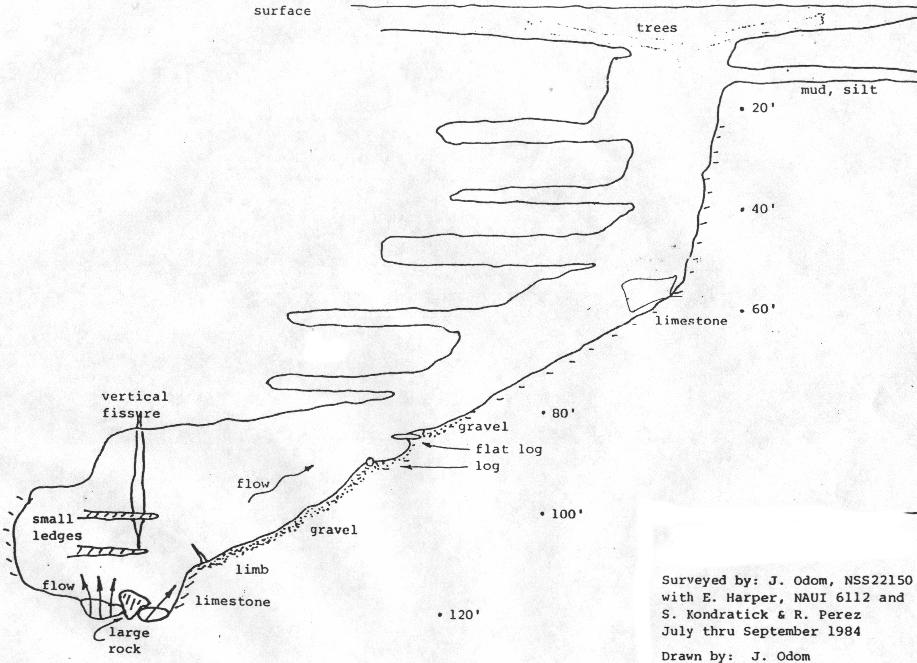
The spring itself is 120 feet deep and descends at an angle. Open Water divers are allowed to dive to 60 feet with a buddy. However, a Cave Diving certification is required below 60 feet. A map of the spring is available here.
When you arrive at Blue Spring State Park, you'll see there are two entry points--one adjacent to the parking lot and another a short walk up the spring run closer to the spring. I recommend divers walk up the spring run and enter near the spring. When you enter the water, walk backwards along the edge of the spring run with your fins in your hands until you reach the spring. While the water along the edge of the spring run is shallow, the current is strong, so be careful. Then, gear up and start your dive. As you descend, you'll fight the current to enter the spring. Watch your breathing to ensure you don't overexert yourself. Once you enter the spring, watch the ceiling so that you don't hit your head or your first stage. I've heard rumors of divers losing their masks due to the strong current, so you may want to pull your mask straps tighter than usual.
Once you ascend from the spring, I recommend divers let the current carry them down to the entry point adjacent to the parking lot. The spring run is shallow, yet home to diverse wildlife--like the Florida Spotted Gar, South American Armored Catfish, Redear Sunfish, Blue Tilapia, Black Crappie, American Alligator and Snapping Turtle. If you're lucky, you might even see a manatee like I did. Unfortunately, I didn't have my video lights during this trip, so I wasn't able to shoot video in the spring.
Blue Springs, Florida from Joe Roualdes on Vimeo.
Admission is $6.00 per vehicle--limit 2-8 people per vehicle--and $4.00 single occupant vehicle.
Posted by jroualdes at 04:20 PM | Comments (0)
September 30, 2010
Mozambique Shark Fin Trade Growing
BBC, Phillipe Cousteau Jr. and his team recently visited Mozambique to document the growing shark fin trade. According to the below clip from the film, most people in the country live off just $1 per day. It’s obvious why shark fining is so appealing when the fins from a large shark are worth as much as $60. Just "six sharks can provide a year's income,” says the narrator.
Unfortunately, the export of shark fins is so lucrative that it has kept regulation protecting sharks from being passed in Mozambique.
Posted by jroualdes at 10:19 PM | Comments (0)
September 23, 2010
Mala Warf Dive Profile
Last month, I visited Maui to dive Black Rock, Slaughter House, Five Caves, Old Airport Beach and my personal favorite... Mala Warf -- also called Mala Ramp and Lahaina Pier. I love diving Mala Warf for several reasons:
- Environment: Mala Warf was originally a concrete pier built to load agriculture from the island onto ships. Eventually, it was closed and collapsed into the ocean. What remains is a pile of concrete slabs turned artificial reef littered across the ocean floor 25 to 30 feet below the surface. Many of the slabs have created tipis large enough to swim through.
- Location, location, location: It's located less than five minutes North of Lahaina and 10 minutes South Kannapali. Since I live in San Francisco and regularly drive more than two hours down to Monterey and Carmel to dive, I appreciate the short drive. I also don't mind recapping dives with friends over Mai Tais at Mala Ocean Tavern right up the street.
- Wildlife: Mala Warf is best known for being home to several white tip reef sharks and a cleaning station for green sea turtles. On my visits, I've come across everything from eels to frog fish to scorpion fish. A dive master at Maui Dive Shop told me she's even seen a tiger shark at the North West point of the dive site.
The white tip reef sharks, schooling fish and the green sea turtle resting on the concrete structure in the video below were shot at Mala Warf and provide insight into what to expect.
Maui 2010 Video from Joe Roualdes on Vimeo.
Beware though... a boat ramp adjacent to Mala Warf is still active. When diving the site, divers must swim through a boat channel. Do not dive the site without a dive flag. Otherwise, you'll wind up as chum.
To get to Mala Warf from Kannapali, head South on State Highway 30 --also called Honoapiilani Highway. Veer right at Canoe Restaurant onto Front Street. Turn right at the small church on the right with the neon sign on its roof. Stay right -- do not veer left onto Ala Moana Street. Drive straight and you'll hit Mala Warf.
Plenty of parking is available. Once you're geared up, head down to the crescent beach located to the right of the boat ramp. While fenced off, part of Mala Warf still stands. Surface swim beyond the boat channel, then veer left towards the Warf that's still standing. Descend there, swimming to the right or beach side of the dive site. Swim counter clockwise around the wreckage, ending where you started.
For more information, click here.
Posted by jroualdes at 12:56 AM | Comments (0)
September 20, 2010
Ban Shark Fining in the Bahamas
While it seems unthinkable, commercial shark fining in the Bahamas may soon be legal. SUNCO Wholesale Seafood Ltd. is exploring the export of shark fins caught in the Bahamas. Despite contributing to the Bahamas' growing eco-tourism sector, sharks are unprotected because they've never been commercially fished in the country. "Tourism as an industry not only accounts for over 60 percent of the Bahamian GDP, but provides jobs for more than half the country's workforce," according to Encyclopedia of the Nations.
In response, dive master Cristina Zenato, conservationist Pedro Baranda and local and international environmental groups have teamed up to draft legislation that bans fining in the Bahamas. They've even launched an online petition asking the Prime Minister, Minister of Tourism and Minister of Agriculture and Marine Resources to ban fining.
According to the petition, which has garnered more than 6,000 signatures, "Every year, up to 73 million sharks are slaughtered for their fins, meat, cartilage, liver and skin. And 30 percent of shark species are threatened or near threatened with extinction."
Joe Romeiro has also lent his support. Last week, the filmmaker posted the below short film, called "Nina Salerosa," on YouTube to illustrate the gentler side of Caribbean reef sharks.
To sign the online petition, click here.
Posted by jroualdes at 11:09 PM | Comments (0)
August 29, 2010
Shinning Light on Video Lights
A beginners guide to video lights
Lumens? Kelvin? Color temperature? Halogen versus LEDs? The world of video lights can be a confusing one for new underwater videographers. If you're looking for the perfect video light to add to your rig, here's what you need to know...
Why You Need Video Lights
Light is emitted from the sun in the form of various wave lengths. Longer wave lengths, like red and orange, are more quickly absorbed by water than short ones, like blue and green. Put simply, the deeper you descend and/or the further away you are from your subject, the more blue-green in color your video will be… unless you dive shallow and shoot close to your subject or utilize artificial light.
This is a photo taken from a video shot 18 feet below the surface using natural light. While the reef in the foreground is colorful, the background gradually becomes more blue-green in color the further away it is from the lens. I didn't need to use artificial light because I was shallow, the sun was intense and there was very little matter in the water.
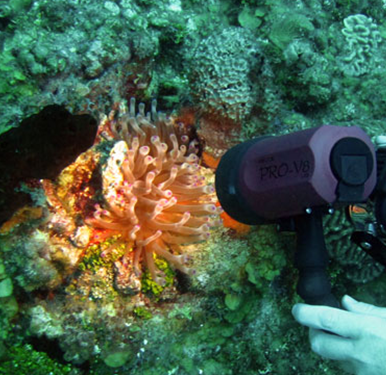
Once you descend below 20 feet, you'll likely need to use artificial light. This photo, taken by Conrad and Carol 45 feet below the surface, clearly demonstrates the importance of using artificial light. While the anemone illuminated by the Ikelite PRO-V8 Video Light is colorful, the area outside the beam is blue-green in color.
LED Versus Halogen
Light-emitting diodes, or LEDs, are the new black in lighting. LEDs are popular among dive and video light manufacturers because they are small, energy efficient and durable. They are expensive to produce though, making dive and video lights featuring them more expensive than halogen-based products.
In contrast, halogen light bulb-based products are cheaper to produce, but less efficient, durable and environmentally friendly than LEDs. Therefore, most dive and video light vendors have discontinued their Halogen-based products in favor of LEDs.
Light Lingo
Like any industry, video lights have their own lingo. Here’s what everything means and why it matters to you...
• Lumens: The brightness of a light. Three-hundred lumens is less bright than 500 lumens. Many video lights allow you to adjust brightness. For example, the Light & Motion SOLA600 switches between 600/300/150 lumens.
• Kelvin: The color temperature, or warmth or coolness, of a light. The smaller the number, the warmer the light. The larger the number, the cooler the light. While difficult to articulate, here’s a great example: Incandescent light bulbs, which are popular in households, give off a warm yellowish light (warm), while new energy-efficient light bulbs emit a white light (cool). Natural daylight, for example, is around 5,500 kelvin, while LEDs are around 6,000-9,000 kelvin.
• Color Correction Filter: Filters that make video light color temperatures warmer. These filters, like the Fisheye LED Twin Filter/Diffuser, easily attach to video lights. They unfortunately also significantly reduce the brightness of the light.
What You Need to Get Started
• A camcorder or still camera: Most point-and-shoot cameras record video, as do some digital SLRs, like the Canon 5D Mark II and 7D and Nikon D300s and D3100.
• An underwater housing:
- Point-and-shoot: Ikelite makes inexpensive housings. Some vendors, like Canon and Olympus, make their own housings too. Review both options and compare prices, ergonomics and features.
- Digital SLRs: Vendors include Ikelite, SeaCam, Subal, Aquatica, Nauticam and Sea & Sea. Prices range from $1,300 to more than $5,000 depending on the material the housing is comprised of and its features. If price is your key consideration, Ikelite is likely your best choice. Make sure you demo all the housings you’re considering since cost, features and ergonomics vary.
- Camcorders: Vendors include Light & Motion, Seatool, Aquatica and Gates. Like with Digital SLRs, make sure you demo all the housings you’re considering.
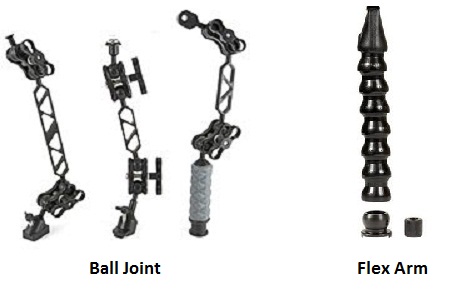
• Arms: They extend from housing handles and easily attach to video lights. There are two types of arms – ball joint and flex arm. Both work well, but ball joint arms are more flexible and expensive. Here’s what they look like:
• Video Lights: While it’s best to use two video lights to reduce shadows, using one is better than none.
Which Video Light is Best?
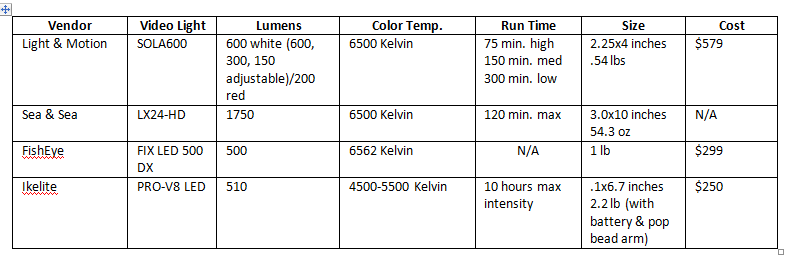
That depends on your budget and what you’re hoping to achieve. To help you decide, below is a comparison of the entry-level video lights offered by prominent video light vendors.
Most Common Errors
What most commonly ruins a perfectly good video is backscatter – matter illuminated by video lights. Here’s what backscatter looks like:
Example of Backscatter from Joe Roualdes on Vimeo.
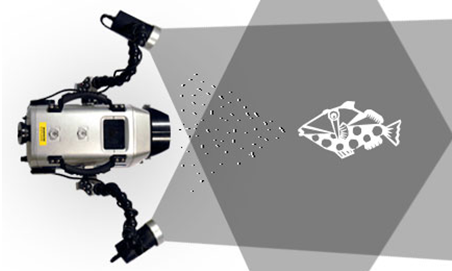
See the dandruff-like spots throughout the video? Backscatter occurs when video lights are angled in, illuminating the space between the lens and subject, which is exactly the mistake I made when shooting video of this puffer fish. Here’s a great illustration featured in a Backscatter article by Sy Harris.
To ensure that backscatter doesn’t ruin your video, angle your video lights so that their inner edges illuminate your subject and create a dark space between the lens and subject. Here is an illustration of this technique (from Sy’s article also).
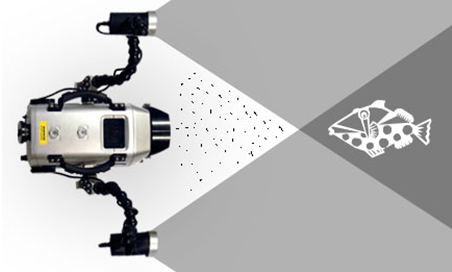
As you can see, the space between the lens and subject is free of light and doesn’t illuminate matter.
Hot spots -- an area of your video that is significantly brighter than the rest -- are also another phenomenon you want to avoid. They are caused by reflective surfaces, like sand or fish, and overexposing a high-contrast photo. To prevent hot spots, check your exposure and turn down your video light lumens if possible or point your strobes away from reflective subjects.
Always remember to wipe bubbles off your dome before shooting video. If you don’t, you’ll wind up with tiny bubbles that reflect the sun and ruin your video.
Important Shooting Techniques
Write this down, it’s important… always keep the sun at your back. It will help reduce shadows. If you shoot into the sun, the area behind your subject may be dark. To determine the direction of the sun, hold your hand up at the beginning of each dive. The side of your hand that’s illuminated marks the direction the sun is coming from.
Don’t rely on zoom -- get as close to your subject as possible! Most video lights only project light several feet. By getting close to your subject you limit the backscatter, illuminate your subject and get a sharper video.
Remember to shoot your subject at various different distances and angles. Viewers typically tire of videos that don’t transition after 10 seconds. Therefore, shoot an establishing video that places your subject in a scene, then transition to a close up shot.
Use the rule of thirds, which states that your composition should be divided into nine equal parts -– two equally-spaced horizontal lines and two equally-spaced vertical lines. Your subject should be placed along those lines to create the best composition. Note that most camcorders and still cameras have a feature that allows you to turn on and off a grid on your LCD screen.
Everyone has video of fish swimming. Differentiate your videos from others by filming fish doing something different, like hunting, hiding or mating. The more you can make your video standout from the rest, the better.
We hope you found our guide to video lights illuminating -– pun intended. Let us know if you have any questions or comments. We’re currently out testing Light & Motions new SOLA600 video and focus light. Keep an eye out for our review next week.
Posted by jroualdes at 03:50 PM | Comments (0)
August 27, 2010
Underwater Video Tips & Tricks From a Pro
Becky Kagan, Owner of Liquid Productions, LLC, recently posted a super-helpful video on underwatervideography.com that highlights video techniques -- plan your shots before getting into the water.
One of the techniques she highlights is getting video of subjects from multiple angles and distances -- wide, medium and tight. For me, that's been a difficult yet rewarding lesson to learn. On a recent dive trip to Maui, I camea cross a white tip reef shark. Worried I wouldnt get any video of it at all, I simply turned on my Canon 7D, adjusted the apperature and ISO and hit record. The result was a three-minute long video of the sharks backside.
Reviewing the video that evening I realized I'd blown the shot. When I came across a green sea turtle the next day, I took my time, shot it from multiple angles and distances. The resulting video is much more appealing.
I hope you're able to learn something new from the video.
Posted by jroualdes at 02:48 PM | Comments (0)
July 27, 2010
New Underwater Housing, Arms and Video Lights... Oh My!
Today's as close to Christmas as I'll ever get in August. My new Ikelite Canon 7D housing, 8 inch dome port and Ultralight arms finally arrived! As an added bonus, Light & Motion sent me two brand new SOLA600 video lights to review.
You know that dog you occasionally see standing outside the grocery store, fixated on the entrance, anxiously waiting for its owner to appear? Yeah, that was me this morning. Except I was waiting for the UPS guy.
Here's everything assembled...
What's the reason for the new rig you ask? I'm headed to Key Largo and Maui, where I'll write an article about shooting video with digital SLRs, a beginners guide to video lights, a review of the new SOLA600 video light and overviews of various dive sites.
I don't plan to post those articles until after I return at the end of August. However, I'll blog throughout my adventures... so keep an eye out for sneak peaks, first takes, photos and videos.
Posted by jroualdes at 06:06 PM | Comments (0)
July 13, 2010
Great Web Site for Underwater Videographers
I'm about six years late, but I recently discovered Vimeo -- an online community where filmmakers and video creators can share their creative work. Think YouTube, but with HD-quality video and social features that help you connect with your favorite videographers, track their work and view their favorite videos.
Here are a few underwater videographers whose work I've enjoyed:
I highly recommend you check out Vimeo if you're an aspiring underwater videographer, like myself, or simply enjoy underwater films.
Posted by jroualdes at 12:33 AM | Comments (0)
July 08, 2010
Farallon Islands Becoming a Popular Swim Hole
Karen Rogers, a 43-year-old Bay Area native, planned to swim 30 miles from the Farallon Islands to San Francisco Bay last Friday -- becoming the first woman and third person overall to do so. Strong winds and 12-foot waves forced her to abort the swim though early Friday morning.
Last month, a relay team attempted to swim from the Farallon Islands to the Golden Gate Bridge, but fell short when one swimmer became disoriented due to the 49-degree water.
While I admire Karen and the relay teams' attempts from a human endurance standpoint, the Farallones are a nutorious salad bar for large great white sharks -- especially this time of year. In fact, the first person to attempt the swim, Ted Erikson, reportedly swam within 50 feet of three great white sharks before they were scared away with gun shots from a support boat.
I realize sharks donn't intentionally attack people. However, if you willingly dive into their buffet, you become fair game in my book. I'm left asking myself... Is it worth the personal risk and the potential shark backlash from the public if one of the great white sharks mistakes Karen for a steller sea lion?
I don't think so. Do you?
Posted by jroualdes at 06:20 AM | Comments (0)
July 07, 2010
Great White Shark Warning Issued in Channel Islands
Last week, the National Park Service issued a great white shark warning around Santa Barbara Island in the Channel Islands -- a chain of eight islands located off the coast of Southern California that are popular among divers.
The warning said there have recently been three attacks on California sea lions by great white sharks -- one at the Santa Barbara Island Landing Cove and two offshore of Cat Canyon on the southeast side of the island.
When I teach PADI Open Water classes, students often ask me if there are great white sharks in Monterey Bay. While everyone knows the answer is “yes,” a lot of questions remain, like:
- Roughly how many great white sharks are in the bay?
- What percentage are male versus female or adults versus adolescents?
- Where are they located?
- Are great white shark numbers in the bay increasing or decreasing?
I’ve always wanted to provide students with a better response than “Yes, great white sharks are in the bay.” Prompted by this warning, I’ve contacted several great white shark experts, including representatives of the Monterey Bay Aquarium's Great White Shark Project, to answer questions like the ones above and develop a post that sheds more light on great white shark behavior in the bay.
Stay tuned!
Posted by jroualdes at 05:14 AM | Comments (0)
June 28, 2010
Taking a Bite Out of SHARK WEEK
Next month marks the 23rd anniversary of cable’s longest-running event -- SHARK WEEK. I used to consider SHARK WEEK a holiday second only to Christmas. These days though, I’m not a fan.
The Discovery Channel says SHARK WEEK helps "viewers learn more about one of the ocean's most imperiled creatures and how they can help save them from the threats of overfishing and habitat loss." Sounds good, right? Absolutely! Where do I sign? It’s unclear though how the programs support that statement when you review what the Discovery Channel calls “SHARK WEEK 2009 highlights”:
"Great White Appetite" conducted "experiments that uncover the great white sharks unique eating habits." In reality, the show’s host – a former Navy Seal – fed a great white shark five whole tuna to determine the limit of its appetite. I don’t think tuna-on-a-rope qualifies as a unique eating habit.
Les Stroud – whose Survivorman show I enjoy – hosted "Deadly Waters." During the program, Les tested the waters in the world’s “sharkiest hotspots” to answer one simple question: Which water is the deadliest?
Another program, titled "Day of the Shark 2," illustrated what happens “when a great white shark breaks through a 300-pound aluminum shark cage and traps the divers inside."
How do these programs help viewers learn about sharks and how they can help save them? I don’t know.
On the flip side, some SHARK WEEK programs claim sharks are harmless. One program exemplifies this: In 2007, shark behaviorist Dr. Erich K. Ritter hosted a program about bull sharks, which are known for their aggressive behavior. Standing in a bay amidst several bull sharks, some up to eight feet long, Ritter says, “They realize were not a threat to them and they couldn’t care less.” Seconds later a bull shark who apparently could care less removes Ritter’s left calve in one bite.
While sharks aren’t out to kill people and most don’t pose a threat, some sharks are dangerous. While Ritter certainly understands sharks better than most, the fact remains that sharks are wild and unpredictable. I have no problem with experts introducing people to harmless sharks to disprove the popular “man eater” stereotype, but it’s dangerous for experts to present all sharks as harmless.
I’m hungry for something other than shark bite survival and breaching great white shark programs. This year, SHARK WEEK will have to chum the Discovery Channel with less sensational and more educational programming to lure me in.
Posted by jroualdes at 07:49 PM | Comments (0)
June 25, 2010
Stuck Between a Reef and a Hammer
A word to the wise diver: Expect the unexpected and always prepare for the worst. I know, I know. You've heard it before from various dive instructors, assistant instructors and dive masters. While some of you will heed my advice, others – yes you – will need to learn this lesson the hard way, just like I did.
My girlfriend Carolina and I recently took advantage of a trip to Boca Raton, Florida, for two weddings to get a boat dive in. We conducted research prior to the dive to identify the dive spots we were most interested in and qualified to dive. When we, along with another diver from Minnesota, boarded the boat the morning of our dive, the dive master asked if we had any dive spot requests. We anxiously suggested a spot that interested us because it’s one of the best dives to spot reef sharks. I love sharks, so saying I wasn’t disappointed when the dive master said we wouldn’t see sharks this time of year is an understatement. Deflated, I pumped myself back up thinking about the turquoise blue waters awaiting us.
With 10 minutes to go before we hit the water, the dive master began his overview of the dive spot. Our max depth was 60 feet. We were supposed to keep an eye out for lion fish on the reef and manta rays, sail fish and turtles during our ascent. While the excitement of the upcoming dive makes some divers’ minds wander during these critical overviews, Carolina and I listened to his every word since this was only our third drift dive. Since there were only three divers, the diver master opted not to dive with us. After the overview, Carolina and I discussed our dive plan with the other diver. He planned to look for lobsters, while Carolina and I would take photos of interesting critters. We’d stay together and at 1,000 PSI, we’d head to the surface. We ran through signals, checked each other’s gear and then suited up.
One giant stride later we discovered more bad news – while we had a sunny skies and little wind, visibility was reduced to merely 30 feet due to a storm that had blown through a few days earlier. Oh well, still better than Monterey’s average visibility, I thought. Once we finished our decent, I took the lead with Carolina a few feet behind and to my right. The Minnesota diver darted back-and-forth inspecting every nook and cranny that could be harboring lobsters.
Despite the poor visibility, we spotted a sting ray, sea turtle, several large lobsters and numerous large sponges. As I surveyed the reef, amazed by how quickly the current was carrying us, I felt a tug on my right fin. Turning to my right nonchalantly, my mind cycled through a list of things Carolina may have spotted: a manta ray, dolphin, or maybe even an elusive frog fish! Interrupting me mid thought, Carolina pulled up along my right side and wrapped her left arm around my right as our eyes locked. Her eye lids were wide open, fully exposing the whites of her eyes – not good!
Behind Carolina, a shadow emerged. Again my mind cycled through images, attempting to define the outline quickly approaching us. Seal… no. Dolphin… no. Manta Ray… no. Shark… yes! But it wasn’t a reef shark. Nearly 20 feet away, its outline was unmistakable. It was a scalloped hammerhead and it was big – 8 feet at least with a dark grey, muscular body that effortlessly cut through the water. First, I was in awe. Then my instinctive fight or flight response kicked in. This was the first shark I’d come across that was large enough to pose a threat. Carolina and I had planned what we’d do if we came across much smaller reef sharks, not a hammerhead. What do we do? We knew our hand signals, but there weren’t enough hand signals or time to sufficiently communicate in this situation. Fortunately for us, the hammerhead banked a u-turn around us and then leisurely swam off. Amidst pulling the regulator out of our mouths to smile and exchanging rapid-fire hand signals illustrating our excitement, the other diver swam up with his hands out asking what all the fuss was about. I gave him the sign for shark, and then extended my arms all the way out to emphasize how large it was. Unfortunately for him, he’d had his head in a hole searching for lobsters and missed the whole thing.
After boarding the boat a few minutes later, I turned to the dive master and said, “You said it’s not shark season. Does that include 8 foot-long hammerheads?” All kidding aside, Carolina and I were lucky. While we hadn’t planned for it, we’d seen a large hammerhead without any issues arising. Chatting over dinner that night, we realized that despite all the research we’d done and questions we’d asked we hadn’t planned for the unexpected and prepared for the worst. While no one – including our dive master who had dived that spot numerous times beforehand – expected us to see a large hammerhead, we came across one. Carolina and I should have taken it upon ourselves to identify all the potentially hazardous animals located in the area and planned how we’d respond if we came across each of them. While the hammerhead simply swam off, what if it hadn’t? What if it we’re inquisitive, didn’t leave the area and we were on low air? What if the diver from Minnesota panicked and shot to the surface?
At the end of the day, every diver is responsible for his or her own safety. While seeing certain things may be highly unlikely, always consider all the things you could come across during your dive and plan for them in advance. Here are a few suggestions to help you prepare for your next dive:
· If you dive with a dive shop, call prior to your dive and ask for an overview of all the marine life you could come across during your dive. Most importantly, ask for a list of all the potentially hazardous marine life. Then, prior to your dive, double check the information you received with your dive master.
· If you’re conducting a dive and don’t have access to a dive shop or divers who are familiar with the site, search online for overviews of your dive site. One site I visit frequently before conducting beach dives is www.shorediving.com, which provides maps of the dive site and overviews of marine life and hazards.
· Become a member of the Divers Alert Network and complete some of the training courses.
· Complete PADIs Rescue Diver course. The course teaches valuable skills that teach you to save your dive buddy and yourself.
· If you dive with a partner, always establish a dive plan, review hand signals and review their gear so you understand how it works. If it’s the first time you’ve gone diving with that person, conduct your first dive together in shallow water with good conditions to evaluate their abilities before taking on more challenging dives.
· Always abort a dive if conditions are poor or you feel you are not qualified to make the dive.
Posted by conradb212 at 04:43 PM | Comments (0)