<?xml version="1.0" encoding="utf-8"?>
<feed version="0.3" xmlns="http://purl.org/atom/ns#" xmlns:dc="http://purl.org/dc/elements/1.1/" xml:lang="en">
<title>Expert Scuba</title>
<link rel="alternate" type="text/html" href="http://www.conradblickenstorfer.com/scuba/mt/expert/" />
<modified>2008-04-11T16:39:52Z</modified>
<tagline>Experience the wonders of Scuba with NAUI instructor Carol Cotton Walker!  [Back to ScubaDiverInfo]</tagline>
<id>tag:www.conradblickenstorfer.com,2008:/scuba/mt/expert/2</id>
<generator url="http://www.movabletype.org/" version="3.17">Movable Type</generator>
<copyright>Copyright (c) 2008, Carol</copyright>
<entry>
<title>Weight: Fresh Water versus Salt Water</title>
<link rel="alternate" type="text/html" href="http://www.conradblickenstorfer.com/scuba/mt/expert/archives/2008/04/weight_fresh_wa.html" />
<modified>2008-04-11T16:39:52Z</modified>
<issued>2008-04-11T16:39:33Z</issued>
<id>tag:www.conradblickenstorfer.com,2008:/scuba/mt/expert/2.196</id>
<created>2008-04-11T16:39:33Z</created>
<summary type="text/plain">Recently, a site visitor emailed me and asked about the difference between weight in salt water and weight in fresh water. Weighing 175 pounds and usually carrying 12 pounds of weight, he wondered how much he should be using for...</summary>
<author>
<name>Carol</name>
<url>www.scubadiverinfo.com</url>
<email>carol@scubadiverinfo.com</email>
</author>

<content type="text/html" mode="escaped" xml:lang="en" xml:base="http://www.conradblickenstorfer.com/scuba/mt/expert/">
<![CDATA[<p>Recently, a site visitor emailed me and asked about the difference between weight in salt water and weight in fresh water. Weighing 175 pounds and usually carrying 12 pounds of weight, he wondered how much he should be using for fresh water diving. </p>

<p>Well, there are a lot of variables in determining the amount of weight you need in fresh water versus saltwater. Generally, people need approximately five pounds less in freshwater than they'd use in saltwater IF they are using the same gear configuration. Major considerations are exposure wear (type, thickness, and age) and the type of tank. </p>

<p>As an Instructor, I usually tell people wearing 7mm rental wetsuits and an 80 cubic foot aluminum tank to begin with 10% of their body weight. For a person weighing 175 pounds, I'd suggest starting with 18 pounds, to keep it even. If you're too negatively buoyant or wearing less neoprene, obviously you'd drop weights until you can sink with an empty BC after exhaling, but float at eye level with a full breath of air in your lungs.</p>

<p>If you will be using a steel tank, depending on the size and brand, you will wear less weights. As an example, a low pressure (2400psi) 80 cf tank is approximately six pounds negative, so a diver can automatically make an adjustment of six pounds of lead from his/her weightbelt. </p>

<p>When I dive in the ocean wearing a skin 2mm wetsuit, I generally wear 6 - 8 pounds of lead. However, when I am wearing a 2mm wetsuit in fresh water with a steel 80cf tank, I don't wear any weights at all. Last August when Conrad and I dived Lake Tahoe I wore a 4/3 wetsuit. On the first day I used a low pressure (2400 psi) 95 cubic foot tank with no weights, hood or gloves and I was just about perfect. On the second day I added a hood and gloves and switched to a high pressure 130 cubic foot tank and was extremely negatively buoyant. I had no choice in that situation other than to switch tanks, but none were available. So, I made the best of the situation, went on the dive, added air to my BC, and had a wonderful dive! :-) </p>

<p>Bottom line is that you need about five pounds less in fresh water than in salt water. The exact gear configuration (wetsuit, tank, BC, etc.) also makes a difference. All too often, divers are over-weighted in most diving conditions. In turn, this affects their buoyancy and can greatly increase their air consumption.</p>]]>

</content>
</entry>
<entry>
<title>New Year&apos;s Resolutions</title>
<link rel="alternate" type="text/html" href="http://www.conradblickenstorfer.com/scuba/mt/expert/archives/2008/01/new_years_resol.html" />
<modified>2008-01-02T22:58:38Z</modified>
<issued>2008-01-02T19:52:48Z</issued>
<id>tag:www.conradblickenstorfer.com,2008:/scuba/mt/expert/2.138</id>
<created>2008-01-02T19:52:48Z</created>
<summary type="text/plain">Well, here it is ... 2008 already. Let me begin by wishing everyone a wonderful, healthy, happy new year filled with lots of excellent diving possibilities! My, how time flies! It seems like only last weekend I was diving at...</summary>
<author>
<name>Carol</name>
<url>www.scubadiverinfo.com</url>
<email>carol@scubadiverinfo.com</email>
</author>

<content type="text/html" mode="escaped" xml:lang="en" xml:base="http://www.conradblickenstorfer.com/scuba/mt/expert/">
<![CDATA[<p>Well, here it is ... 2008 already. Let me begin by wishing everyone a wonderful, healthy, happy new year filled with lots of excellent diving possibilities!</p>

<p>My, how time flies! It seems like only last weekend I was diving at Loch Low-Minn doing the Haunted Night Dive. Ok, I must have been stuck in a time warp or something because it's been since then that I've posted anything! My bad! </p>

<p>I'm not a fan of New Year's Resolutions because all too often they are broken within days of making them. But, if we make reasonable resolutions then maybe ... just maybe we can actually keep them!</p>

<p>I chose today to add to my blog for a number of reasons ... it's 2008 ... I'm home sick with a horrible cold today ... and I've been slacking on writing!</p>

<p>2008 will be a great year ... I can feel it. A new year represents new birth and new beginnings. Events happen, lives change, jobs change, relationships change. These things can change within a blink of an eye and often we can do nothing to alter the event, leaving us to adapt to the consequences. Being more positive and upbeat will help. Looking at the good always helps.</p>

<p>2008 will be a great year ... For diving, as well. Take some time and look at a map and research areas of interest. Talk to dive shops and dive travel specialists and local dive experts. Those are the very best sources of information about dive locations. I love to travel and I love to dive. That combination makes dive travel a natural interest for me. I will make an effort to add to our "<a href="http://www.scubadiverinfo.com/2_places.html">Places</a>" page as often as I can. 2007 was not a good year for dive travel for me, as I didn't go out of the country even once. I did, however, go dive Lake Tahoe with Conrad to do reviews of dive cameras and that was a lot of fun! If you ever get the opportunity to dive there, we both recommend going ... but take a thick wetsuit or get trained in drysuit and get plenty of practice in before you go!</p>

<p>I'm home sick with a horrible cold today. I almost NEVER get sick, but here I am with a cold. I don't know where I got it, but I'm sure I got it because of lack of sleep and the added stress of the Holidays. Making a resolution to maintain good health is an excellent idea. Maintaining good health is optimum for diving as well. Eat foods that are good for you and low in the bad stuff that can cause health issues later on down the road. Get plenty of rest. We all need a certain amount of sleep each day, and I am going to do better at getting more sleep. Taking time for quiet time during the day is good for our health as well. I plan on taking time during my lunch hours at work each day to get a few moments of "Carol" time. Lower your stress level however you can, including simplifying your life and surroundings. Getting rid of clutter helps! Exercising more to keep in good cardio condition, swimming, and diving frequently will help each and every one of us be better divers. The only way to be a great diver and maintain a high comfort level is to dive frequently. Oftentimes my past students tell me they'd like a little time in the pool to refresh their skills. I have no problem with them returning to the pool during my pool sessions and refreshing their skills a little. If fact, I urge them to do so! Besides them getting more comfortable, coming back as a certified diver and watching students might just get them fired up about furtherung their diving career. </p>

<p>And, finally, I have been rather slack on making contributions to this blog. I vow to do better in 2008. Do me a favor, gang, and send me emails on what you'd like to see added to our site, ok? We want to know what YOU all want to learn about! </p>

<p>Ok, it's time for me to go rest again. I'm dringing orange juice and eating chicken noodle soup ... And other remedies I'm forgetting? :-)</p>]]>

</content>
</entry>
<entry>
<title>Another advanced class and the Haunted Night Dive 2007</title>
<link rel="alternate" type="text/html" href="http://www.conradblickenstorfer.com/scuba/mt/expert/archives/2007/11/another_advance.html" />
<modified>2007-11-11T06:35:57Z</modified>
<issued>2007-11-10T19:20:36Z</issued>
<id>tag:www.conradblickenstorfer.com,2007:/scuba/mt/expert/2.74</id>
<created>2007-11-10T19:20:36Z</created>
<summary type="text/plain">The weekend of October 27th and 28th was all a blur for me! We had done our annual Haunted Night Dive Halloween underwater decorations at Loch Low Minn quarry, and at the same time I was teaching an Advanced class...</summary>
<author>
<name>Carol</name>
<url>www.scubadiverinfo.com</url>
<email>carol@scubadiverinfo.com</email>
</author>

<content type="text/html" mode="escaped" xml:lang="en" xml:base="http://www.conradblickenstorfer.com/scuba/mt/expert/">
<![CDATA[<p>The weekend of October 27th and 28th was all a blur for me! We had done our annual Haunted Night Dive Halloween underwater decorations at Loch Low Minn quarry, and at the same time I was teaching an Advanced class there. So Saturday morning we loaded the truck with our dive gear and set off to get some bagels, a few groceries, fuel, and then drive on down there to the quarry.</p>

<p>We got a dozen of my favorite Cinnamon Crunch bagels at Panera's bakery, then headed for the highway. As we turned onto it, I heard a WSSSSHHHHHHHHHHHHHH sound coming from the bed of the truck. Bummer! One of the tanks' valve had opened up in the turn!</p>

<p>Fortunately, the dive shop was only less than half a mile away, so going back there was no big deal. The tank, however had completely drained by the time we got there. Of course, it was one of mine! Brad was there at the shop, so we left it for him to fill with 38% Nitrox. My students would be at the shop in a few hours, so he'd ask Dean to bring the filled tank to me. We stopped at the grocery store for beer and dry ice, filled up the truck, and then finally began the 45-minute drive down to Loch Low Minn. </p>

<p>We got to the quarry around 11:30am. My helpers were already there, so there was no time to waste. We unloaded and assembled gear, organized and sorted underwater decorations, then donned our gear began a frenzy of underwater prop preparations and installations.</p>

<p>As for the class, one of my more challenging students, Buck, showed up two hours early, cigarette in hand and looking non-too-fresh. He wanted to know what he could do to help and did his best to entertain each of us with his stories, but we finally managed to get underwater and start our work, while Buck remained at the shore.</p>

<p>I scurried around underwater placing props, repositioning props, and tying cylumes in pumpkins, etc., until it was time for my students to get there. I got out long enough to brief them on what we were going to be doing for the NAUI Advanced class.</p>

<p>They all geared up, got in the water, and we began with the skills they were required to master for the class. First we worked on buoyancy, then did the surface air consumption calculation (SAC) dive. It's good to do the SAC dive second because it allows students to fine-tunes potential buoyancy issues. This time, the SAC dive was a 20 minute stay at 35 feet, followed by a safety stop. </p>

<p>Buck apparently heard the beat of a different drummer and did the majority of his SAC dive well below 40 feet, possibly assuming the dive plan didn't apply to him and deeper was better. Good thing I didn't take them over "the pit" -- the deepest part of the quarry! I reminded them all that the depth of a dive is agreed on, and not where the bottom is. I asked Buck what he'd do if he was diving the South Wall at Grand Cayman where the Cayman Trench was SIX THOUSAND feet deep!!!? I am not sure he understood. Go figure. I don't think it's too much to ask of a student to follow basic instructions. I will never compromise safety, and those who do not understand that will not dive.</p>

<p>My friend Rhonda then arrived to do the night dive with us. That will finish up the requirements for her own NAUI Advanced Diver certification. So, my dive master Dewey, five students, and I all prepare for the night dive. By now, 25 or 30 people are all planning on entering the water within five minutes or so of each other, some for their night dive training, others to see the underwater Halloween decorations, and others both.</p>

<p>So off we go, Dewey leading my flock with Rhonda as his dive buddy, then Carol and Buck, then Aric and Dean, followed up by me. I count divers and come up one short. It's Buck. </p>

<p>"I can't get down!" he yells, wearing a 7mm wetsuit, a steel-95 tank, and 20 pounds of weight. I go get him and tell him to calm down, relax, cross his feet, let the air out of his BC, and he starts going down like an anchor -- not a rock -- an ANCHOR. Except there's one thing keeping him. He's now all tangled up in the line that's attached to the 15-foot hang bar under the dock. He looks like a dolphin in a tuna net. He's screaming "I'm tangled up in a line!!!" So I tell him to chill out and stay still! One tug and he's free, but by this time I have no clue as to where all my other students and Dewey are. I make Buck follow me. I swim towards the shine of the flashlights below, and lo and behold, there they are. Somehow, surprise, I lose Buck in the group, but gain Carol.</p>

<p>So now Dewey has Rhonda, Buck, Aric, and Dean, and I have Carol. We were not all meant to stay together, but I knew they were all in good hands with Dewey and Rhonda. So Carol and I take off over the pit where we had heard the paddlefish were hanging out. No such luck, but we still had fun!</p>

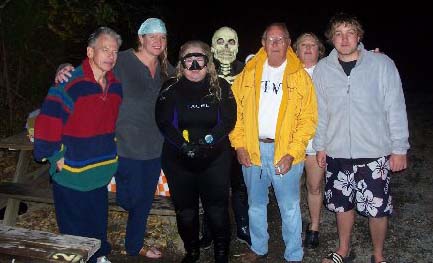
<p><img src="http://www.scubadiverinfo.com/images/advanced_class_nov07.jpg"></p>

<p>Everyone loved the Halloween decorations. The skeleton wearing a tank, BC, and mask was great.  Beside it was a severed leg wearing a dive boot and fin ... Nessie had been busy eating divers! Unfortunately, I totally forgot the camera and its underwater housing! Nothing underwater would have looked good at all anyway. The visibility was HORRIBLE. </p>

<p>Back on land, we shot some funny videos though. Dewey had my skeleton mask and hands on, along with his dive gear. Rhonda came up and took off her mask, Carol asked her how her dive was, Rhonda got really excited about it and started telling about the fish and all. Dewey came up behind her and Carol began screaming. Dewey grabbed Rhonda and pulled her backwards into the water.</p>

<p>I told them I wouldn't be doing the Haunted Dive project next year as it is just too much work. But I will be donating all the props and will offer my services as a consultant for next year's event.</p>

<p>After all the students got out, I asked Dewey if he wanted to go back for a while with me and he said it would be his pleasure. So away we went! Half an hour later we still hadn't seen any paddlefish, at 50 feet deep and, believe me, we TRIED to find them!! I felt fine afterwards, and was probably the most energetic of our group at the end of the night.</p>

<p>To give you an idea of what it's like for an instructor with some extra project duty, here's my dive profile for the day:</p>

<p>#1 - 40 feet for 75 minutes<br />
45 minute surface interval<br />
#2 - 40 feet for 45 minutes<br />
30 minute surface interval<br />
#3 - 50 feet for 30 minutes<br />
15 minute surface interval<br />
#4 - 40 feet for 45 minutes<br />
60 minute surface interval <br />
#5 - 40 feet for 60 minutes<br />
15 minute surface interval<br />
#6 - 50 feet for 30 minutes</p>

<p>Now do you understand why my body is so tired, even with 38% Nitrox? I'm finding out I'm not a spring chicken anymore!</p>

<p>After the dive, Ted started a fire, lit the grill, and it was time to cook dinner and relax. Rhonda had brought the most incredible steaks, twice baked potatoes and salad. I brought okra, at her request. There were lots of people hanging out and visiting all four campfires, but after all the diving, soon everyone in our group wanted to go to sleep. Rhonda and I shared a cabin, as did Ted and Dewey.</p>

<p>I had a gut feeling none of us would be fit for diving the next day, so I planned the second part of the certification dives for the following Saturday. So after we all got up, had bagels for breakfast, loaded up our gear, talked to Quarry owners Rick and Stacy for a few minutes, we drove back home. I unloaded the dive gear, took a long hot bath, slept in the tub, did laundry, slept for three hours, and then watched two of my favorite shows on TV. A long weekend of diving was over. </p>]]>

</content>
</entry>
<entry>
<title>What the heck is that??!?</title>
<link rel="alternate" type="text/html" href="http://www.conradblickenstorfer.com/scuba/mt/expert/archives/2007/07/what_the_heck_i.html" />
<modified>2007-11-10T18:15:46Z</modified>
<issued>2007-07-15T16:15:26Z</issued>
<id>tag:www.conradblickenstorfer.com,2007:/scuba/mt/expert/2.73</id>
<created>2007-07-15T16:15:26Z</created>
<summary type="text/plain">That&apos;s probably the most commonly heard question when asking someone if they&apos;ve ever seen a Paddlefish. And, it&apos;s also the most common question one asks when they see a Paddlefish! Let me begin by answering a few commonly asked questions....</summary>
<author>
<name>Carol</name>
<url>www.scubadiverinfo.com</url>
<email>carol@scubadiverinfo.com</email>
</author>

<content type="text/html" mode="escaped" xml:lang="en" xml:base="http://www.conradblickenstorfer.com/scuba/mt/expert/">
<![CDATA[<p>That's probably the most commonly heard question when asking someone if they've ever seen a Paddlefish. And, it's also the most common question one asks when they see a Paddlefish!</p>

<p>Let me begin by answering a few commonly asked questions.</p>

<p><strong>What is a Paddlefish?</strong></p>

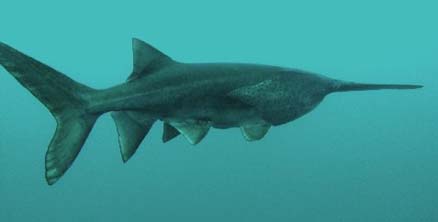
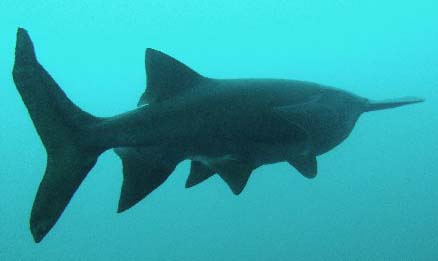
<p>One of the oldest fishes, Paddlefish fossils date back to 300 to 400 million years ago. The first dinosaurs didn't appear for 50 million years later! There are two types of Paddlefish. The ones we have here in North America and the ones that are found in China. Living half a planet apart, they have quite different characteristics. Their snout, often called a rostrum, is the biggest difference between them. The North American Paddlefish have a long paddle-shaped rostrum, where the Chinese paddlefish have cone-shaped snouts.</p>

<p><strong>Where might I see a Paddlefish?</strong></p>

<p>Most frequently in rivers that are tributaries of the Mississippi River, and in the Mississippi River, itself. There are a few quarries where Paddlefish have been successfully transplanted.</p>

<p>Paddlefish seem to like deep, slow moving waters, as opposed to rapid currents. Paddlefish are quick to travel, as they have been seen in locations as much as 2000 miles apart!</p>

<p><strong>How big does a Paddlefish get? And, how long do they live?</strong><br />
Paddlefish can grow in excess of 5 feet in length and can easily weigh up to 80 pounds and more. It has been my observation that they grow quickly. The Paddlefish that I am familiar with were anywhere for 7 - 12 inches in length last September, and are well over 24 inches in length now. I'm looking forward to watching them grow to adulthood! I read somewhere that the record Paddlefish was 198 pounds!</p>

<p>It's not unheard of for Paddlefish to live 50 years and longer. </p>

<p><strong>What do Paddlefish eat?</strong></p>

<p>They live off of a diet of zooplankton. They open their mouths wide as they swim through the water, collecting zooplankton as everything else is filtered out through their gills arches. Their gills filter the water with "gill rakers." It's an awesome sight to see these creatures swim quickly through the water gathering food!</p>

<p><strong>Are Paddlefish related to sharks?</strong></p>

<p>Even though there are similarities between sharks and Paddlefish, they are not closely related, if at all. Both have a skeleton made up primarily of cartilage. They both have forked tails with one half of their tail being larger than the other.</p>

<p>I have the good fortune of living within an hours drive of a quarry that stocks Paddlefish. As I mentioned earlier, these fish were acclimated to the quarry last September. Much research had to be done before the fish were released, and divers had to be made aware of their fragile state.</p>

<p><img src="http://www.scubadiverinfo.com/images/paddlefish_elizabeth.jpg"></p>

<p>Paddlefish are shy fish. They avoid people and tend to hang out in the quarry where most divers don't go. Everything I've read has indicated they are deepwater fish and prefer dark, cold, still water, but I have been seeing them in the shallower part of the water table. We've even seen them while snorkeling! I must admit, we were snorkeling over the deepest part of the quarry, so don't go looking in shallow water for them!</p>

<p><img src="http://www.scubadiverinfo.com/images/paddlefish.jpg"></p>

<p>I have asked the owners of the quarry if I can donate a book with the intent of having other divers help to identify each fish. I have noticed that some have distinctive markings, or scars, or nicks in their fins, and some even have different colorations. At least one even has a stubby rostrum! I'm not sure if each one is as individualized as some of the big critters we identify by their markings, like giant manta rays, but if they are, we will all learn from this experience.</p>

<p>I also wonder if they have any sort of long or short term memory. I have definitely seen the same one on more than one occasion over the past few weeks, and this past weekend it stayed close enough to me that I could have reached out and touched it at any given moment for more than a few minutes! I have three sections of video totalling over five minutes at VERY close range! I'm told this is rare, but I suppose I've always been called Dr. Doolittle, Jr. for a reason. ;-)</p>]]>

</content>
</entry>
<entry>
<title>Underwater Photography Explored</title>
<link rel="alternate" type="text/html" href="http://www.conradblickenstorfer.com/scuba/mt/expert/archives/2007/06/underwater_phot.html" />
<modified>2007-11-10T18:15:16Z</modified>
<issued>2007-06-14T16:14:50Z</issued>
<id>tag:www.conradblickenstorfer.com,2007:/scuba/mt/expert/2.72</id>
<created>2007-06-14T16:14:50Z</created>
<summary type="text/plain">More years ago than I&apos;d like to admit, I took my first real photography class while in college. I learned a lot, took a lot of pictures, even did my own darkroom work using black and white! It was quite...</summary>
<author>
<name>Carol</name>
<url>www.scubadiverinfo.com</url>
<email>carol@scubadiverinfo.com</email>
</author>

<content type="text/html" mode="escaped" xml:lang="en" xml:base="http://www.conradblickenstorfer.com/scuba/mt/expert/">
<![CDATA[<p>More years ago than I'd like to admit, I took my first real photography class while in college. I learned a lot, took a lot of pictures, even did my own darkroom work using black and white! It was quite an exciting experience, and now that excitement has transferred over to digital photography. </p>

<p>My old airbrush is covered in dust, now. The icon for Adobe Photoshop has a shortcut on my desktop. Film has been replaced with memory cards of different shapes, sizes and storage space. Digital cameras are priced well within reason, and new ones come out daily, making digital photography easier, better, quicker and more convenient than a film photographer could ever dream of!</p>

<p>Many people say that George Eastmann invented the camera back in 1888, but photographic images date back even centuries before then. Alexander Wolcott applied for and received the first American patent in photography in 1840 for his camera. But no matter who actually invented the camera, I'm sure they would totally flip if they could see what their creation has evolved into!</p>

<p>Cameras, film, patents, memory ... This isn't what I intend to write about, but it brings up many thoughts to ponder.</p>

<p>I LOVE photography. It's challenging to me. My depth perception is off, due to the difference in focal length of my eyes, so it's almost like I have an advantage in this two dimensional medium.</p>

<p><img src="http://www.scubadiverinfo.com/images/scuba_101_3.jpg" align="left" hspace="4">What truly presents a challenge is handling and successfully using a camera underwater. For years, the likes of waterproof Nikonos cameras have been in the hands of professional and amateur photographers alike. And, for years photographers have been baffled with the differences a photographer faces by shooting pictures underwater. </p>
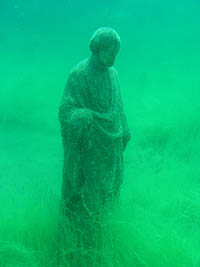
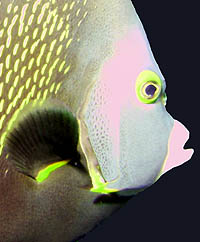
<p>As a diver you know objects appear 25% larger and 25% closer, colors are absorbed by order of energy the deeper we dive. "ROY G BIV" is how many remember the order in which colors are absorbed. By 25 feet red is all but gone, at 35 orange goes, at 45 feet yellow is gone, and eventually everything looks inky purple. Indigo, actually. Indigo and gray. Blah. We've always been told lights help, and our eyes do compensate somewhat, but not enough to bring all the colors back. </p>

<p>Digital cameras come in all shapes and sizes, different megapixel capacity, different zoom lengths, different colors, different features, different memory cards, different batteries, different warranties; they are all different. It can be confusing which camera to purchase, but please take a few minutes and read what we have to say about the cameras we have been fortunate enough to review. Keep checking back, as we are constantly receiving new underwater camera equipment to try out and present our opinion about! </p>

<p>Now ... A word about actual underwater photography ... What you've been waiting for!</p>

<p>For all the reasons I listed above, taking photographs underwater is more challenging than on land. In addition to color absorption, refraction, distortion, and polarization, we also have to deal with depths, times, currents, surge, temperature, sunlight penetration, and most of all, our subjects ... critters! It takes a huge bucket of patience to photograph fish underwater. </p>

<p>Many fish have never seen the likes of humans, and they are often scared back into the safety of their homes. Take your time and be extraordinarily patient. Hover motionless whenever possible, slow your breathing down, concentrate on your subject, have your camera as ready as possible before you find something you want to photograph. </p>

<p>Many digital cameras automatically shut down to save battery life after a few minutes on inactivity, so be aware you might have to turn your camera back on before you take a photograph. Looking through a viewfinder, if your digital camera still has one, is more difficult because you're wearing your mask, so your eye will be farther away from the viewfinder than normal. </p>

<p><img src="http://www.scubadiverinfo.com/images/scuba_101_2.jpg" align="right" hspace="4">Look into the viewfinder and see what all will be in the frame. Know the boundaries, and try to imagine in your mind what you want to fill the frame. Wait patiently for the critter to move into place. Relax, hover, breathe slowly, concentrate. Now, take the picture. Take another. And another. Remember, the worst thing that will happen is you might need to delete a frame or two. It's not like the days of film when you had 24 or 36 exposures and you were done! And, who knows ... You might happen to take a fabulous picture you might otherwise have missed!</p>
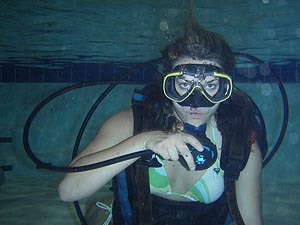
<p>Practice is important. Don't be discouraged if you don't get great results the first time you use your camera underwater. Don't get upset and delete them all right away. Take time to look at them and learn from them. Keep a journal and write down what the conditions were like, where you were, what depth you were at, and anything else that you might think is important. Everything you keep a record of will help you in the future. We write in a logbook, don't we? We refer back to it on occasion, don't we? You should for photography as well!</p>

<p>Adobe Photoshop, or another competent photo editing software program, is a must. Invest in a good photo editing program and use it to enhance your photos. Use editing software to crop your photos, straighten your photos, and adjust the color in your photos. Don't go overboard with the "auto" features as they often make underwater photographs look fake. Sometimes it's fun to take an out-of-focus photo and do crazy things with it like adjusting the color saturation to where it's drastically altered from its original state. Crop it. Blur it. Manipulate it. This can be fun when creating abstract art. </p>

<p><img src="http://www.scubadiverinfo.com/images/scuba_101_1.jpg" align="left" hspace="4">Lighting is important. Digital cameras come equipped with a small built-in flash. These flashes can prove handy, especially when used with a diffuser. Diffusers help eliminate backscatter. Backscatter is the small particulate or sediment that's suspended in the water. We don't always see it with the naked eye, but the flash sees it and makes spots on the image. A diffuser will soften the backscatter and often eliminate it completely, as the light from the flash won't reflect off of it.</p>

<p>Okay, so those were some basics about underwater photography. PLEASE feel free to contact me if you have questions I've not covered. As with most things, I'm sure I will think of more to say, and Part II will be born. </p>

<p>My best advice to you about underwater photography?</p>

<p><b>Do it!</b> Take the plunge and buy as good of a camera as you can afford. Most of us travel long distances to dive in beautiful, tropical locations, so why not have memories we can keep forever!</p>

<p><b>Practice!</b> As with any aspect of diving, the more we practice, the more comfortable we become. Underwater photography is no different! One benefit that most people discover when they take up underwater photography is their buoyancy drastically improves, their air consumption improves, and their comfort level improves! </p>

<p><b>Be patient!</b> Good things come to those who wait, and that doesn't exclude underwater photographers, believe me! Hovering, relaxing, and being patient will bring you incredible photographic rewards!</p>

<p>***Note***<br />
Please visit our gallery to see examples of my underwater photography, as well as several of my friends.</p>]]>

</content>
</entry>
<entry>
<title>Refreshing!</title>
<link rel="alternate" type="text/html" href="http://www.conradblickenstorfer.com/scuba/mt/expert/archives/2007/05/refreshing.html" />
<modified>2007-11-10T18:14:34Z</modified>
<issued>2007-05-14T16:14:13Z</issued>
<id>tag:www.conradblickenstorfer.com,2007:/scuba/mt/expert/2.71</id>
<created>2007-05-14T16:14:13Z</created>
<summary type="text/plain">Okay, so you&apos;ve not been diving in a while. The weather&apos;s getting warm, the days are getting longer, and your dive gear is getting dusty ... AND ... You are getting rusty!!! It&apos;s time to get wet, folks! For those...</summary>
<author>
<name>Carol</name>
<url>www.scubadiverinfo.com</url>
<email>carol@scubadiverinfo.com</email>
</author>

<content type="text/html" mode="escaped" xml:lang="en" xml:base="http://www.conradblickenstorfer.com/scuba/mt/expert/">
<![CDATA[<p>Okay, so you've not been diving in a while. The weather's getting warm, the days are getting longer, and your dive gear is getting dusty ... AND ... You are getting rusty!!! </p>

<p>It's time to get wet, folks! For those of us who are not fortunate to live in a place where it's warm all year, diving locally can be a bit limited. Oh, don't get me wrong, there are pieces of equipment that will help extend your scuba diving season. A drysuit being one of them. Hood and gloves are a must this time of year in Tennessee and well as California. As Conrad mentioned in his latest blog entry, it's no fun putting on a wetsuit, but it is a necessity in a lot of cases. So go shake the critters our of your wetsuit, call your local dive shop and set up a time for a refresher, or see if you and a certified buddy can rent the pool for an hour or so of much needed bubble blowing time!</p>

<p>Once you have your pool time scheduled, don't get in a hurry. Remember you're dealing with Life Support Equipment and it needs to be properly hooked up. Oh, and before you do that giant stride into the deep end, be sure to check your buddy's gear and make sure they have checked yours. BEFORE you enter the water is the best time to discover malfunctions, improper assembly, or even differences in equipment and how everything functions.</p>

<p>Once you both are ready, and you've entered the pool, be sure to spend some time in the shallow end just getting used to blowing bubble again. Close your eyes and imagine faraway tropical places ... OK, wake up! It's time to see if you remember all the basic skills. Does your regulator purge properly? Can you recover it if it gets knocked out of your mouth? Can you find it if it's hiding from you? Don't forget, scuba divers don't have immunity from Murphy's Law ... "If is can go wrong, it will." Well, in diving that law should read, "If it can go wrong, it might, and usually at the farthest away point from the entry!"</p>

<p>So your regulator and you are friends once again. Good! And your mask? Flood and clear it a few times ... Remove it and replace it. Don't forget: any hair under the skirt will cause your mask to leak. Oh, and that wetsuit hood? Make sure the skirt of your mask is <i>under</i> the edge of your hood all the way around! </p>

<p>How about sharing air? Do you and your buddy both remember how to do that? Were you trained to do it the same way? Now's the time to find out ... Not 80 feet deep in the ocean when one of you has a catastrophic air failure or just plain gets excited and forgets to check your gauges. Should that ever happen? NOOOooooo!! Check your gauges often! Make sure your buddy checks his, too.</p>

<p>Buoyancy. There's a good one. Practice staying just off the bottom while in the shallow end. We will do more of this once we get to the deep end in a bit. For now, re-familiarize yourself with all the many ways to dump air from your buoyancy compensator. You should have checked all of these when you assembled your equipment before getting in the pool, so everything should function properly.</p>

<p>And now for the deep end. Yep, that 15 foot deep area seems shallow, but remember that buoyancy is the hardest in that range. Spend a lot of time practicing buoyancy control, then try to do all of your basic skills with your buddy while remaining neutrally buoyant ... not so easy, eh? It can be done!</p>

<p>Feeling better about your skills now? Good! You see? It is worth the time and effort to refresh your skills in a confined environment. Now that you are comfortable, even your first dive during your trip will be easy and relaxed. </p>

<p>All too often people who dive infrequently go on dive trips and spend the first day or two getting comfortable in the water again. Why not do that BEFORE you go on that expensive dive vacation where bottom time is limited ... It simply makes perfect sense!</p>

<p>Now, go call your dive shop and get that pool time reserved ... Don't wait!</p>

<p>><)))'> <'(((><</p>]]>

</content>
</entry>
<entry>
<title>AAAHHHH CHOOOO!!!</title>
<link rel="alternate" type="text/html" href="http://www.conradblickenstorfer.com/scuba/mt/expert/archives/2007/05/aaahhhh_choooo.html" />
<modified>2007-11-10T18:14:02Z</modified>
<issued>2007-05-12T16:13:40Z</issued>
<id>tag:www.conradblickenstorfer.com,2007:/scuba/mt/expert/2.70</id>
<created>2007-05-12T16:13:40Z</created>
<summary type="text/plain">Are you one of the lucky people who suffer from allergies? I sure am! And here I am, living in the allergy capital of the world! Maybe not, but it sure seems that way! Please remember that I am NOT...</summary>
<author>
<name>Carol</name>
<url>www.scubadiverinfo.com</url>
<email>carol@scubadiverinfo.com</email>
</author>

<content type="text/html" mode="escaped" xml:lang="en" xml:base="http://www.conradblickenstorfer.com/scuba/mt/expert/">
<![CDATA[<p>Are you one of the lucky people who suffer from allergies? I sure am! And here I am, living in the allergy capital of the world! Maybe not, but it sure seems that way!</p>

<p>Please remember that I am NOT a doctor, and I'm not offering advice, just telling you little tricks that I do to help me prepare for a dive during allergy season. </p>

<p>For starters, I try not to plan too many dives during the time I know I am going to have problems with allergies. I've never been officially tested for pollen allergies, but many different varieties seem to bother me. So for me, it's safe to assume if it's pollen, it's going to irritate my system. Dogwood tree pollen is awful, as is pine tree pollen. Both look incredibly mean when viewed through a microscope, so I can see why they are such harsh irritants!</p>

<p>If I do want or need to dive during allergy season, I use mild medications that Diver's Alert Network have deemed safe for diving. I also try them out on land, well in advance of the day of my dive. If I suffer from side effects above water, it's better to know well in advance so I can look for alternative methods. Many people don't realize the effects you experience from medicines on land will be amplified when underwater, as well as their effectiveness wears off sooner underwater.</p>

<p>Don't overstay your welcome. What I mean by that is make sure you don't stay down longer than your medication will last. When underwater, we generally don't breathe through our noses very much, except for a little to equalize the pressure inside your mask as you descend. So it's not always easy to tell when your sinuses are blocked ... Well, until you start to ascend, that is! </p>

<p>Believe me, if you've never had a reverse block while ascending, consider yourself lucky! I was in the Bahamas a few years ago and during one of our last dives, my sinuses became clogged up. While ascending, I thought my head was going to explode! Ok, that's a slight exaggeration, but it sure did feel like it might! In all honesty, sinuses can be damaged by having a reverse block, so please remember to ascend very slowly and exhale through your nose more freguently to clear your air passages and help any mucus expel on its own. </p>

<p>I will be conducting two weekends of checkout dives beginning this coming weekend. For over a week now I've had problems with my allergies. Please keep your fingers crossed that I will get better before Saturday!</p>]]>

</content>
</entry>
<entry>
<title>Being a good dive buddy ...</title>
<link rel="alternate" type="text/html" href="http://www.conradblickenstorfer.com/scuba/mt/expert/archives/2007/03/being_a_good_di.html" />
<modified>2007-11-10T18:13:29Z</modified>
<issued>2007-03-25T16:11:26Z</issued>
<id>tag:www.conradblickenstorfer.com,2007:/scuba/mt/expert/2.69</id>
<created>2007-03-25T16:11:26Z</created>
<summary type="text/plain">There&apos;s more to being a good dive buddy that simply agreeing to dive with someone. First, to be a good dive buddy you must have adequate training and experience for the dive you intend to make. It&apos;s always nice to...</summary>
<author>
<name>Carol</name>
<url>www.scubadiverinfo.com</url>
<email>carol@scubadiverinfo.com</email>
</author>

<content type="text/html" mode="escaped" xml:lang="en" xml:base="http://www.conradblickenstorfer.com/scuba/mt/expert/">
<![CDATA[<p>There's more to being a good dive buddy that simply agreeing to dive with someone. </p>

<p>First, to be a good dive buddy you must have adequate training and experience for the dive you intend to make. It's always nice to go diving with a buddy who has more experience than you do, but that's not always the case. Be confident in your own abilities. </p>

<p>Second, you must have adequate equipment, and a complete understanding of how it all works. Scuba equipment is life support equipment and must be treated as such. It is essential to make sure your equipment is always properly maintained and is stored properly.</p>

<p>Third, you must communicate with your potential dive buddy and agree on a dive plan. Before you ever hit the water with a new dive buddy, it is important to find out about their training history, diving experience, and diving frequency. Discuss things you learned in your training. It's not always part of a beginning scuba diving course to perform a rescue or to learn all about all the barotraumas in great detail. Ask questions. Volunteer information. Agree to practice a few basic skills together in shallow water to refamiliarize yourself on skills. Go over hand signals. Always remember good communication skills can make it or break it in any relatioship, not just underwater. Be the kind of dive budddy you'd like to have!  </p>

<p>Fourth, you and your buddy must check each other's gear to make sure it is functioning, and also make sure you completely understand how it all works. There can be subtle differences in how different brands and styles function. </p>

<p>And, always remember ... Plan your dive and dive your plan. :-)</p>]]>

</content>
</entry>
<entry>
<title>Diving Year-Round</title>
<link rel="alternate" type="text/html" href="http://www.conradblickenstorfer.com/scuba/mt/expert/archives/2007/02/diving_year-rou.html" />
<modified>2007-11-10T18:11:18Z</modified>
<issued>2007-02-25T16:10:59Z</issued>
<id>tag:www.conradblickenstorfer.com,2007:/scuba/mt/expert/2.68</id>
<created>2007-02-25T16:10:59Z</created>
<summary type="text/plain">It&apos;s been too long since my last entry, and for that I must apologize. As we all know, sometimes life gets in the way. You want to go diving, but the water is still too cold, eh? Well, we DO...</summary>
<author>
<name>Carol</name>
<url>www.scubadiverinfo.com</url>
<email>carol@scubadiverinfo.com</email>
</author>

<content type="text/html" mode="escaped" xml:lang="en" xml:base="http://www.conradblickenstorfer.com/scuba/mt/expert/">
<![CDATA[<p>It's been too long since my last entry, and for that I must apologize. As we all know, sometimes life gets in the way. </p>

<p>You want to go diving, but the water is still too cold, eh? Well, we DO have options! You can book a trip to some exotic place, or you could check into taking a drysuit class.</p>

<p><strong>Let's first discuss exotic places ...</strong></p>

<p>As you may or may not know, I compiled a list of over 80 dive sites. Together, Conrad and I located all of these sites so you can see them from a satellite imaging software, plus we have added a few videos that actually show the locations. The list is not a complete list of all the places I've been, but it's a start. We will be adding more as time goes by. </p>

<p>Check with your local dive shop to see what trips they are offering. Divers often feel like they are drying out over the winter months and want to go somewhere warm and tropical. These trips can be anything from a long weekend to Cozumel, a driving trip to the springs in Florida, to week long adventures to the caribbean, or even extended trips to the South Pacific! It's all in what you want and what you can budget for. </p>

<p><strong>Diving Dry ...</strong></p>

<p>Local diving has it's appeal, as well. If you are like me, in that your local diving consists of rock quarries, take note ... The water is usually infinitely clearer in the winter, due to the lack of algae bloom and people stirring it up. It's not uncommon for a quarry to have 75 - 100 feet of visibility in the winter months!</p>

<p>But to dive for any length of time during the winter, a drysuit is often required. You don't have to own a drysuit to learn how to use one, but training is essential. Again, check with your local dive shop to see what they have to offer. The dive shop where I teach has a full line of DUI rental drysuits and undergarments in all sizes that are available for the training sessions and may be rented, as well. Worn with thick gloves and hood, your diving time can be tripled, at least! Wearing a wetsuit in frigidly cool water might get you through one dive, but that is all for most people. </p>

<p>It might be too late for you to budget for either of these options for this season, and local diving is just around the corner with warm days we will soon be having. But, keep in mind either getting the training you need in a drysuit for next winter, or check into a trip to a warm destination.</p>

<p>Next stop? Not sure yet ... Somewhere in the Caribbean, perhaps? :-)</p>]]>

</content>
</entry>
<entry>
<title>&apos;Tis The Season</title>
<link rel="alternate" type="text/html" href="http://www.conradblickenstorfer.com/scuba/mt/expert/archives/2006/12/tis_the_season.html" />
<modified>2007-11-10T18:10:46Z</modified>
<issued>2006-12-02T16:10:16Z</issued>
<id>tag:www.conradblickenstorfer.com,2006:/scuba/mt/expert/2.67</id>
<created>2006-12-02T16:10:16Z</created>
<summary type="text/plain">Happy Holidays, everyone! If you are like me you have scuba divers on your gift giving list this holiday season. Having problems deciding what to give them? Depending on how much you plan on spending, the options can be limitless!...</summary>
<author>
<name>Carol</name>
<url>www.scubadiverinfo.com</url>
<email>carol@scubadiverinfo.com</email>
</author>

<content type="text/html" mode="escaped" xml:lang="en" xml:base="http://www.conradblickenstorfer.com/scuba/mt/expert/">
<![CDATA[<p>Happy Holidays, everyone! If you are like me you have scuba divers on your gift giving list this holiday season. Having problems deciding what to give them? Depending on how much you plan on spending, the options can be limitless! Your local dive shop will have lots of things for you to choose from. Simply ask! If they were trained at the shop, there's a very good chance the staff will know the people on your list. The dive shop will possibly have ideas and suggestions for you about your divers' wish list. In all the years I managed a dive shop, one of the things I always did was keep a list of what people said they wanted. That way when friends or family came in trying to decide on a gift but had no ideas, I could ask a few questions and guide them in the right direction!</p>

<p>For inexpensive gifts, consider a <b>spare dive light</b>, a <b>pair of gloves</b>, a <b>knife</b>, a <b>dry box</b>, a <b>T-shirt</b>, or even a <b>save-a-dive kit</b>. If your scuba friend is planning on going on a trip there's a good chance they have an <b>open balance</b> on the trip. And most dive shops will accept payments for your friend and give you a certificate to present to your friend.</p>

<p>For those wanting to spend a bit more, do some investigative work to find out what size your diver wears and what they need, then make your decisions based on that. Most dive shops will allow for exchanges after Christmas, assuming the item has not been used. Items you might consider are <b>wetsuits</b>, <b>buoyancy compensators</b>, <b>regulators</b>, <b>computers</b>, <b>gear bags</b>, or <b>instruments</b>.</p>

<p>If you are not concerned about the price, consider a <b>complete scuba package</b>, as many dive shops offer package deals. Another option is to <b>pay for a trip</b> your diver has been interested in, or give them a <b>drysuit</b>.</p>

<p>Your friend or relative isn't a diver yet, but interested? Or your diver is interested in learning more? Give them the gift of learning! <b>Scuba classes</b> are often given as gifts, and are always appreciated!</p>

<p>And if all else fails ... There's always <b>gift certificates</b>!</p>

<p>Happy Holidays!  and Safe Diving! </p>]]>

</content>
</entry>
<entry>
<title>Ego ... Know Your Limits</title>
<link rel="alternate" type="text/html" href="http://www.conradblickenstorfer.com/scuba/mt/expert/archives/2006/11/ego_know_your_l.html" />
<modified>2007-11-10T18:10:14Z</modified>
<issued>2006-11-11T16:09:31Z</issued>
<id>tag:www.conradblickenstorfer.com,2006:/scuba/mt/expert/2.66</id>
<created>2006-11-11T16:09:31Z</created>
<summary type="text/plain">&quot;C&apos;mon! Don&apos;t be a fraidicat! You can do it! Chicken! I&apos;ll watch over you ... Trust me!&quot; This is a prime example of someone trying to pressure someone into doing something they aren&apos;t comfortable with. If this happens to you...</summary>
<author>
<name>Carol</name>
<url>www.scubadiverinfo.com</url>
<email>carol@scubadiverinfo.com</email>
</author>

<content type="text/html" mode="escaped" xml:lang="en" xml:base="http://www.conradblickenstorfer.com/scuba/mt/expert/">
<![CDATA[<p>"C'mon! Don't be a fraidicat! You can do it! Chicken! I'll watch over you ... Trust me!"</p>

<p>This is a prime example of someone trying to pressure someone into doing something they aren't comfortable with. If this happens to you and you don't feel comfortable with the dive location or dive plan ... Just say "NO."</p>

<p>As a new diver, you will find there is an endless array of diving opportunities out there. From rivers to quarries to oceans to wrecks to caves ... And many, many more!</p>

<p>What a lot of new divers may not understand is that a lot of diving environments require additional training and certification. Many of the springs in Florida and Mexico offer diving for beginning divers in overhead environments - caverns. During your beginning scuba course, your instructor should have given you an idea of what is off limits. These overhead environments are off limits until you have successfully completed a cavern diving course. Caverns and caves and old wrecks are often very beautiful and seemingly inviting, but they are have the potential of being dangerous to the unsuspecting new diver.</p>

<p>You may be faced with the decision of whether or not to dive based on the conditions or the environment. Please remember that by diving in an uncomfortable frame of mind, or by being nervous, or apprehensive, mistakes can happen. Situations can turn bad quickly and you don't need to add to the potential hazards.</p>

<p>If you find yourself in a situation such as this, keep in mind you are not only putting yourself at risk, but everyone in the dive team, as well.</p>

<p>As a new diver, it's a good idea to dive with other divers who have more experience than you. A seasoned diver can help you in ways other new divers cannot. You will learn different people's skills and habits. You will find ways to do things that better suit you. Watch them. Learn from them. Appreciate them. Remember their kindness and willingness to help you. Once you have more experience you might want to look for a new diver to take under your wing for a while. In doing that, there is a sense of satisfaction that cannot be duplicated.</p>

<p>Who knows ... By helping others you might find you want to become a Dive Master or even an Instructor. I found out very early on that I would choose the leadership path. I have never regretted that decision.</p>]]>

</content>
</entry>
<entry>
<title>How I Conduct a NAUI Advanced Class</title>
<link rel="alternate" type="text/html" href="http://www.conradblickenstorfer.com/scuba/mt/expert/archives/2006/11/how_i_conduct_a.html" />
<modified>2007-11-10T18:09:19Z</modified>
<issued>2006-11-06T16:08:40Z</issued>
<id>tag:www.conradblickenstorfer.com,2006:/scuba/mt/expert/2.65</id>
<created>2006-11-06T16:08:40Z</created>
<summary type="text/plain">When should I enroll in an Advanced Class? What should I expect to come out of the experience with? What do I need to bring with me? What are the requirements? All of these are very good questions to ask....</summary>
<author>
<name>Carol</name>
<url>www.scubadiverinfo.com</url>
<email>carol@scubadiverinfo.com</email>
</author>

<content type="text/html" mode="escaped" xml:lang="en" xml:base="http://www.conradblickenstorfer.com/scuba/mt/expert/">
<![CDATA[<p><li>When should I enroll in an Advanced Class? <br />
<li>What should I expect to come out of the experience with? <br />
<li>What do I need to bring with me?<br />
<li>What are the requirements?</p>

<p>All of these are very good questions to ask. Quite often newly certified divers wonder if they are ready to take my Advanced class and my response is ... by all means ... sign up! I always welcome new divers into my Advanced class. Being asked to help a new diver in continuing their education is a joy and an honor for any instructor.</p>

<p><img src="http://www.scubadiverinfo.com/images/carol_under.jpg" align="left" hspace="4">Brand new divers tend to be eager to learn, and that is good. I enjoy opening new doors for their interests to blossom. I like to think I do so in an encouraging and helpful way. In no way is an Advanced class going to make a person an instant <i>expert</i> in any area. It does, however, give them additional knowledge on which to build upon and enjoy our sport.</p>

<p>A NAUI Advanced Course includes at least six dives in different areas. Depending on where you are taking the course, the types of dives will vary. When completing an Advanced class in the ocean your training will likely include a non-penetration wreck dive and/or a drift dive.</p>

<p>When I teach an Advanced class locally, I usually begin with a <b>buoyancy clinic</b>. We discuss and correct issues such as proper weighting, proper trim in the water, proper finning techniques, and all around general comfort in the water.</p>

<p>All too often beginning divers are <b>over-weighted</b> for their evaluation dives and don't realize how much more efficient they would be with the proper amount of weight, as opposed to what they may have carried previously. Instructors often over-weight so students can stay comfortably on the bottom or on a training platform to practice their basic skills without floundering around. However, getting in the habit of wearing too much weight will hinder good buoyancy skills, and that in turn makes your air consumption worse.</p>

<p>By wearing the correct amount of weight a new diver will find neutral buoyancy much easier to achieve. When you use less air in your BC to remain neutrally buoyant, you have more air to breathe! By being more comfortable in the water your breathing rate will slow down. <b>Better buoyancy + slower breathing = better air consumption + longer bottom time!</b></p>

<p>After everyone in the class has a grip on neutral buoyancy and comfort, we move on to using certain tools. We discuss and demonstrate the use of <b>lift bags</b> and <b>safety markers</b>. I explain that you should never attempt to bring up an object that weighs more than your weightbelt without the use of a lift bag. I explain the features of the lift bags and the function of each feature. I show the students a couple of styles of safety markers. We discuss the pros and cons of each. Once we have completed the workshop we put the lift bag to use! Any tools you might want to use underwater require practice underwater.</p>

<p>On the third dive we put all the components of the first dive into use. We plan a dive to find out what each diver's <b>air consumption rate</b> is. I generally plan the dive to 35 feet, spending 20 minutes at depth, then doing a safety stop at 15 feet for three minutes. Each diver is responsible for remembering his/her own air pressure used. The diver makes note of starting tank pressure and the remaining pressure at the end of 20 minutes at depth.</p>

<p>I explain converting pressure to cubic feet of air used, then calculating air consumption based on the dive. Let's use an aluminum 80 cubic foot tank as an example. Aluminum 80s have a working pressure of 3,000 psi. Divide the tanks volume (80) by working pressure (3000) to find the cubic feet per psi. To find out how many cubic feet of gas used during the designated dive time, multiply the number by the psi used. To find out how much air would have been used at the surface we then divide that number by 2, since 35 feet in fresh water is very close to 2 ATAs. Divide this number by 20 minutes and the answer gives you your air consumption in cubic feet.</p>

<p>Example: 80 cu ft tank, 1000 psi used, 35 feet for 20 minutes.<br />
80/3000 = 0.0266666 X 1000 = 26.6666/2 = 13.3333/20 = 0.666665<br />
This diver's surface air consumption rate would be .66 cubic feet per minute.</p>

<p>New divers often learn their surface air consumption rate is anywhere between .66 and 1.1 cubic feet per minute. The more you dive and the more comfortable you become, the less air you will consume. Knowing how much air you consume on the surface will allow you to better plan your dives. Knowing planned depths and tank volumes, you can figure out roughly how much time you can spend diving.</p>

<p>Next we plan and conduct a <b>night dive</b>. The first rule of night diving is to dive the site in the daytime first. Familiarize yourself with the entry, the exit, and any points of interest you care to see and explore. I demonstrate light signals. I remind everyone to keep your light beam out of everyone's eyes. Acclimating to darkness takes 20 minutes or so, however, losing it takes just a split second! I often add a little challenge to the dive by taking students to a local river. This way they get to familiarize themselves with current, too.</p>

<p>The <b>deep dive</b> is next. We spend time reviewing dive tables. Since the students will also be doing a <b>navigation dive</b> later in the day, they plan both dives and a surface interval based on the information I supply about the dives.</p>

<p>Quite often I conduct the Advanced class at <a href="http://www.lochlow-minn.com/" target="_blank">Loch Low-Minn quarry in Athens, Tennessee</a>. The deepest section of the quarry is roughly 80 feet and not often vey clear. Often the visibility is good, but the ambient light is lacking, due to the algae bloom in the shallower water. One thing everyone will discover is what a thermocline is! And there are things to see: Recently 70+ paddlefish were released in the quarry, and they prefer the deeper water, so I suspect we'll be meeting them during future deep dives there.</p>

<p>Last, but certainly not least, is the navigation dive. This can be challenging, so I save it for last. Successful navigation begins with proper planning of the dive and clarifying the role of each member of the dive team. We introduce indirect read and direct read compasses to the students. We discuss all the features of compasses and demonstrate how to use them. They perform a few patterns on land, then donn gear for surface skills. </p>

<p>We explain the usefulness and importance of measuring distance underwater. Each student then follows a measured line and counts his/her kick cycles. They do this twice and find an average. Each student is given a direction and a distance and asked to do a reciprocal heading back to their starting point. Once this is done, they are asked to swim a square search pattern using kick cycles and the compass in returning to where they began.</p>

<p>And then the fun begins! Each team prepares for their navigation dive, discussing each person's responsibilities. My navigation course is rather unique in that there are no signs of the course from the surface!</p>

<p>A <b>rescue</b> is a required dive for the Advanced certification. Since I include a detailed rescue in my beginning class, I do not dwell on it, but we do discuss proper techniques and practice being victim and the rescuer.</p>

<p>The exact sequence for a successful rescue includes locating the victim, shaking them to see if they respond, and assume control by placing your knees on either side of the victims scuba tank. As you remain above the victim, steadying yourself on their back, be sure to maintain an open airway by cradling his/her chin in your right hand and aiming their face towards the surface. Attempt to bring the victim up by inflating his/her BC. If the victim's scuba tank is empty, you must use your own BC to begin the ascent. Remember the rate of ascent is crucial - no faster than your smallest exhaled bubbles! Once on the surface, call for help,  then check the victim's airway, breathing and circulation. Get the victim out of the water and out of his/her gear, lay him/her flat on his/her back with feet elevated. Call Diver's Alert Network (DAN) at 1-919-684-8111. Do what you can to make the victim comfortable, maintain life support and wait for further instruction and assistance.</p>

<p>And that, my friend, is my Advanced Class! Care to join us? </p>]]>

</content>
</entry>
<entry>
<title>Haunted Night Dive, Anyone?</title>
<link rel="alternate" type="text/html" href="http://www.conradblickenstorfer.com/scuba/mt/expert/archives/2006/11/haunted_night_d.html" />
<modified>2007-11-10T18:08:37Z</modified>
<issued>2006-11-01T16:07:43Z</issued>
<id>tag:www.conradblickenstorfer.com,2006:/scuba/mt/expert/2.64</id>
<created>2006-11-01T16:07:43Z</created>
<summary type="text/plain">Each October for the past few years, there&apos;s been a murmur at Loch Low-Minn quarry of a Haunted Night Dive. Just to set the record straight, it&apos;s not a rumor ... It&apos;s a fact! Ok, so there may not be...</summary>
<author>
<name>Carol</name>
<url>www.scubadiverinfo.com</url>
<email>carol@scubadiverinfo.com</email>
</author>

<content type="text/html" mode="escaped" xml:lang="en" xml:base="http://www.conradblickenstorfer.com/scuba/mt/expert/">
<![CDATA[<p>Each October for the past few years, there's been a murmur at <a href="http://www.lochlow-minn.com/" target="_blank">Loch Low-Minn quarry</a> of a Haunted Night Dive. Just to set the record straight, it's not a rumor ... It's a fact! Ok, so there may not be any REAL ghosts, but there are some that "hang" around underwater!</p>

<p>The idea for a Haunted Night Dive hit me while walking through a Halloween store. Ted and I decided we'd make it a project and have all of my Dive Master candidates participate. </p>

<p>We started gathering monsters and goblins and ghouls ... pumpkins and ghosts and cauldrons ... witches and bats and spiders ... things that go Bump in the night.</p>

<p><img src="http://www.scubadiverinfo.com/images/loch_haunted_skeleton.jpg" align="right" hspace="4">Once everything was on paper, the real planning and preparation began. We figured out what all props we had and drew out a map of the area we were to decorate. Once a route was in place, we began the prep work of the props.</p>

<p>How would we suspend the ghosts? The pumpkins? The bats? How would we illuminate them all? Well, we used a lot of balloons and chemical glow sticks! How would we make the cauldron bubble? Easy! A scuba tank would be attached to a device that would slow the flow of air down. </p>

<p>Over the course of the weekend we learned a few things. First, an inflated balloon is next to impossible to sink! We'd later design another method that would better suit our needs. Second, we learned the chemical glow sticks are an excellent way to illuminate the path! Third, we learned that even by slowing down the flow of air drastically, the air didn't last long enough, so it was back to the drawing board.</p>

<p>This year we perfected some of our techniques and found solutions for other problems. The ghosts were a piece of cake. Each ghost is made up of a white plastic bathroom garbage can turned upside down. Three holes are drilled in the lip of the can to allow for three strings to hold it in place. A small anchor made of concrete was made and strategically placed in the quarry. The strings were attached to these anchors and air was purged into the cans. A white sheet was then draped over the can and two blue chemical glow sticks were placed inside. </p>

<p>The pumpkins were those plastic pails that kids use for Trick or Treating. A hole is drilled in the bottom and a neoprene ring is glued to the underside of the pumpkin to give it more flotation. Without the neoprene, the pumpkin is only slightly positively buoyant. Two glow sticks are attached to a string that runs through the hole in the bottom. The string is then tied to a rock and stays somewhat stationary unless disturbed.</p>

<p>The bubbling cauldron problem was solved with a little thought. Ted found that a few pounds of dry ice, a three pound weight, and three green glow sticks were the answer! The dry ice bubbled for over an hour in water 67 degrees ... Plenty of time for all the divers to see and enjoy the effect.<br />
<p><br />
<img src="http://www.scubadiverinfo.com/images/loch_haunted_cauldron.jpg"><p><br />
My dear friend Donna and her husband Tom donated a coffin last year, so we used it again for a corpse made of a mannequin draped with black fabric, a skeleton mask, skeleton glove hands, and an axe. A glow in the dark tombstone at its head read "R.I.P"</p>

<p>Bats were hanging in trees, tarantulas were also. A witch had "melted" on the quarry floor, leaving behind only a black cape, a broom, and her hat. A pirate was hiding in a rock pile, a ghoul was suspended above the platform, glowing pairs of eyes were lurking amongst the grasses, severed body parts were scattered along the quarry floor, hanging out of a concrete alligator's mouth, and out of the Loch Ness Monster's mouth as well.<br />
<p><img src="http://www.scubadiverinfo.com/images/loch_haunted_arm.jpg"><p><br />
Hot chocolate and flavored coffee awaited all divers once they exited the water. The air temperature was much colder than the 67 degree water, but everyone agrees it's always worth the effort to make this dive.</p>

<p>Next year's Haunted Night Dive will be a bit different. I will not be responsible for pulling the entire thing off. Stacy and Rick and I have decided to get more divers involved by making it more of a contest among individual divers and groups. Everyone will construct their own creative display and place it in the quarry early in the month of October. Everyone will have the opportunity to vote for their favorite display. A night dive will be planned so that everyone can enjoy the area in an eerier light. Later in the month the votes will be tallied and a winner will be announced.</p>

<p>If you'd like more information or suggestions in creating your own Haunted Night Dive, or if you have ideas you'd like to offer, please contact us. We're always open to suggestions!<br />
</p>]]>

</content>
</entry>
<entry>
<title>Back From Little Cayman</title>
<link rel="alternate" type="text/html" href="http://www.conradblickenstorfer.com/scuba/mt/expert/archives/2006/10/back_from_littl.html" />
<modified>2007-11-10T18:07:40Z</modified>
<issued>2006-10-07T16:07:12Z</issued>
<id>tag:www.conradblickenstorfer.com,2006:/scuba/mt/expert/2.63</id>
<created>2006-10-07T16:07:12Z</created>
<summary type="text/plain">Okay, so I&apos;ve been home from Little Cayman for a week now. Seems like adequate time to digest everything. So here goes ... Little Cayman was the destination. Delta and Cayman Air were the means of getting there. Two big...</summary>
<author>
<name>Carol</name>
<url>www.scubadiverinfo.com</url>
<email>carol@scubadiverinfo.com</email>
</author>

<content type="text/html" mode="escaped" xml:lang="en" xml:base="http://www.conradblickenstorfer.com/scuba/mt/expert/">
<![CDATA[<p>Okay, so I've been home from Little Cayman for a week now. Seems like adequate time to digest everything. So here goes ...</p>

<p>Little Cayman was the destination. Delta and Cayman Air were the means of getting there. Two big jets and a small twin engine plane that holds 14 or so passengers and lands on a grass field that's used for soccer when no planes are landing.</p>

<p>Yes, Little Cayman is a small island. I believe it's 11 miles long and 1 mile wide with one main road around the island and one that cuts across it. Electricity is relatively new to the island. It wasn't until the mid 1990s that they even got power! </p>

<p>Karaoke seems to be one of the big highlights of the island, and Little Cayman Beach Resort on a Friday night seems to be the place! I think the locals just like to be entertained by the tourists. :-)</p>

<p>The daily schedule is quite simple. Up by 7:00 for breakfast, on the boat by 7:45 for two dives, back in for lunch around noon, back on the boat at 1:45 for an afternoon dive, then back in time to swim, clean up and/or a nap before dinner. The bar seemed to be open all day and night, but then again, I don't think I ever stayed awake past 10:00 pm!</p>

<p>Speaking of meals, everything was WONDERFUL! They prepare lots of good food that should suit even the pickiest of eaters. Breakfast choices includes cereal, yogurt, muffins, pastries, juices, coffee, tea, tons of fresh fruit, eggs, bacon, sausage, omelets, and some bread-like carbs for extra energy to keep a diver going. Lunch always provided salads, sandwich fixin's, a pasta dish, vegetables, at least one other meat option and awesome desserts. The dinner buffet always offered a huge salad with lots of toppings, vegetables, meat dishes, pasta, and again, wonderful desserts! If you walked away hungry, it was definitely your own fault!</p>

<p>And now ... What everyone has been waiting for ... THE DIVING!</p>

<p>All I can say is WOW!! It's been ages since I've been diving in the Cayman Islands, but I guarantee you it won't be as long before I go back to Little Cayman! <img src="http://scubadiverinfo.com/images/gallery_little_cayman/img16.jpg" align="right" hspace="4">Everyday brought an array of wonderful colors, sounds, and experiences. The days were warm with blue skies and the typical occasional white puffy cloud we all expect when visiting the Caribbean. The water was quite calm and crystal clear. It was easy to see the reefs and critters even from a moving boat! The water temperature registered 88 - 89 degrees on more than one dive computer, so no wetsuits were needed. Some people wore them more as protection than for warmth. On some dive sites there would be a mild current, but nothing that kept us on the boat. We even had great conditions for night diving. Our night dive was on a wreck called the Soto Trader. <img src="http://scubadiverinfo.com/images/gallery_little_cayman/img31.jpg" align="right" hspace="4">We saw tons of HUGE groupers and parrotfish, spotted eels, crabs, lobsters, squid, and tons of varieties of fish ... too many to mention! Several of us had high powered lights for shooting stills or videos and that drew in a rather undesirable critter ... bloodworms. After 45 minute or so they were a bit annoying, but that's something almost everyone was willing to deal with.</p>

<p>As Conrad mentioned, I took well over 400 photographs and I am still in the process of weeding through them. Please check back often to see any new additions to <a href="http://scubadiverinfo.com/images/gallery_little_cayman/">my Cayman Gallery</a>. I told everyone on our boat about this website and promised them all their very own page of photos, if they'd like. Many of them said they'd like to contribute, so as soon as they do we will add another article with links to everyones' photos. </p>

<p>All in all, it was an outstanding trip. For those who are tied to the Internet, they do have wireless access, and a lot of people were hanging around the bar with their laptops. It was a bit weird for an out-of-the-way dive location, but a necessity these days. Due to luggage weight restrictions, I was unable to take this large laptop. Had I had a smaller one, I'd have taken it in a heartbeat!</p>

<p>And now for planning the next dive trip ... :-)<br />
</p>]]>

</content>
</entry>
<entry>
<title>My take on diving with critters</title>
<link rel="alternate" type="text/html" href="http://www.conradblickenstorfer.com/scuba/mt/expert/archives/2006/09/my_take_on_divi.html" />
<modified>2007-11-10T18:07:01Z</modified>
<issued>2006-09-10T16:06:28Z</issued>
<id>tag:www.conradblickenstorfer.com,2006:/scuba/mt/expert/2.62</id>
<created>2006-09-10T16:06:28Z</created>
<summary type="text/plain">I&apos;ve thought long and hard about this topic. All my life I&apos;ve loved interacting with animals and, to be honest, I don&apos;t ever look for that to change. Everyone at work is now calling me &quot;Stingray&quot; because of how I...</summary>
<author>
<name>Carol</name>
<url>www.scubadiverinfo.com</url>
<email>carol@scubadiverinfo.com</email>
</author>

<content type="text/html" mode="escaped" xml:lang="en" xml:base="http://www.conradblickenstorfer.com/scuba/mt/expert/">
<![CDATA[<p>I've thought long and hard about this topic. All my life I've loved interacting with animals and, to be honest, I don't ever look for that to change. Everyone at work is now calling me "Stingray" because of how I replied when they asked me if I'd stop diving now because of how Steve Irwin died.</p>

<p>I never met Steve, but I certainly would have enjoyed that opportunity. I admired him for having the ability to interact with often deadly creatures. I also occasionally thought he was nuts for doing it. All in all, Steve had a wonderful and unique life. I feel such extreme and deep sorrow that he is no longer with us. It saddens me to know that what is often thought of as a docile creature was able to take his life in such an almost impossible manner. So, once again, just as Steve's life was unique, so was his untimely death. </p>

<p>Some may see me as an extremist, too, I suppose. The very thought of being in the water with a creature over 40 feet long thrills me, and in no way intimidates me. Swimming with humpback whales, whale sharks, and a plethora of varieties of sharks and rays has added a great deal to my fondest memories of things that have taken place underwater.</p>

<p>I have been able to visit places such as the Galapagos Islands, Socorro, San Benedicto, the Sea of Cortez, Palau, Yap, Kauai, Channel Islands, Catalina Island, Vancouver Island, the Caribbean, and the Bahamas, to name just a few, I have been fortunate enough to see and interact with a lot of large animals. Animals such as giant manta rays, golden cow rays, marble rays, spotted eagle rays, stingrays, guitar fish, and skates. Sharks such as Hammerheads, Galapagos sharks, silkies, white tips, black tips, silver tips, tiger sharks, bull sharks, sand tigers, nurse sharks, angel sharks, and grey reef sharks. I've also encountered such large critters as Mola Molas, harbour seals, monk seals, sealions, an elephant seal, bottle nose dolphins, and spinner dolphins to name a few! And, yes. I do still have all of my own appendages :-)</p>

<p>One of my first underwater experiences with rays was at Stingray City in Grand Cayman. For many years Stingray City has been known as the World's Best 12' Dive location. And that it is! We were briefed before entering the water about how docile the rays are, how to feed them, how to pet them, and how to avoid the only injury even thought possible ... and that's a "Stingray Hickey!" <br />
<p><br />
<img src="http://www.scubadiverinfo.com/images/manta_01_blog.jpg"><p></p>

<p>How might one receive a Stingray Hickey? Well, it's not easy, but it can happen! Each dive team is given a small plastic container filled with chopped fish. This is stingray food. The container's lid has slits cut in it so that you may stick a couple of your fingers inside to retrieve a piece of the fish. This way not all of the fish will come out of the container. Your goal is to feed the less aggressive females. It's obvious which are females; they are larger than the males. You are instructed to hold the container with the lid up against your body so the scent of the fish does not get in the water around you. My dive buddy, Ted, received a hickey because a male stingray snuck up from behind and tried to get into the container he was holding. Ted was wearing a lined dive skin, and even through the skin, the ray was able to grasp onto his arm flesh and cause a small bruise. Hence, a Stingray Hickey.</p>

<p><img src="http://www.scubadiverinfo.com/images/solmar_v.jpg" align="right" hspace="5">Some of my most memorable events underwater have taken place at Socorro Island, San Benedicto Island, and Roca partida. All of these are enjoyed by booking a trip on the <a href="http://solmarv.com" target="_blank">Solmar V</a> live aboard out of Cabo San Lucas, Mexico. The boat is fabulous and the crew is phenomenal. (If you go there, please tell Captain Pedro, Jose Luis, Pepe, Ray,  Jeronimo, and the rest of the crew that I said hello!) On almost every single dive we encountered giant manta rays. Often we saw lots of sharks, as well. I have had numerous experiences with giant mantas, but two stuck out above all the rest. Back in 2001 when I went there the first time, I had a remarkable experience that I will not go into detail about right now, but I will tell you this... Every day of my life I think about it! </p>

<p>Last December I returned to the islands. During that trip I do believe I found an old manta friend. Her belly markings looked familiar, and she certainly wasn't timid when it came to approaching me! I spent at least 30 minutes during a dive having what I call a religious experience with this manta. I was hovering directly below the boat at 30 feet deep, and was virtually alone, with the exception of this manta ray. I was within sight of the anchor line at all times, the water was crystal clear, and the rest of my dive team was 30 feet below me watching a school of hammerheads being cleaned. The manta ray was not afraid to be touched, nor was she afraid to touch me, often finding myself face to face with this beautiful, majestic creature!</p>

<p>The most harmful encounter I've ever had with any of the creatures has been with sealions. On more than one occasion sealions have grabbed my fins with their teeth. It doesn't help that I always find myself drawn to be right in the middle of the colony, so I'm sure my encounters have been unusual. One one occasion in the Galapagos Islands, a sealion got a little too playful. Instead of just nipping at my fins, he placed his teeth on my calf. He did not hurt me, nor do I believe that was his intention. I totally believe he was playing with me just as a pet dog would play with his master. </p>

<p>All in all, I am enjoying a totally fabulous career in Scuba diving!  I would not change it for the world. The only thing I would do differently is that I would have gotten certified years earlier in my life! <br />]]>

</content>
</entry>

</feed>